


UAE Opens Pillar Two Registration on EmaraTax: What Multinational Groups Need to Know
The UAE has taken another significant step in aligning with international tax standards by officially launching the Pillar Two (Global Minimum Tax) registration portal on EmaraTax.
The Federal Tax Authority (FTA) has now enabled eligible entities to register under the UAE's Domestic Minimum Top-up Tax (DMTT) regime, marking an important milestone for multinational enterprise (MNE) groups operating in the country.
For businesses that are part of large multinational groups with consolidated annual revenues of EUR 750 million or more, this development requires immediate attention and proactive compliance planning.
What is Pillar Two?
Pillar Two is part of the OECD's global tax reform initiative aimed at ensuring that large multinational groups pay a minimum effective tax rate of 15% in every jurisdiction where they operate.
The UAE implemented the Domestic Minimum Top-up Tax (DMTT) framework effective from financial years beginning on or after 1 January 2025, bringing qualifying multinational groups within the scope of the Global Minimum Tax rules.
As a result, affected UAE entities are now required to register through the EmaraTax portal and comply with the reporting obligations prescribed by the FTA.

Who Needs to Register?
Registration generally applies to UAE entities that are members of multinational enterprise groups where the consolidated global revenue meets or exceeds EUR 750 million in at least two of the four preceding financial years.
This may include:
- UAE subsidiaries of multinational groups
- Regional headquarters located in the UAE
- UAE holding companies forming part of a global group
- Permanent establishments of foreign multinational entities
- Other UAE constituent entities within an in-scope MNE group
If your organisation forms part of a large multinational group, assessing your Pillar Two obligations should be a priority.
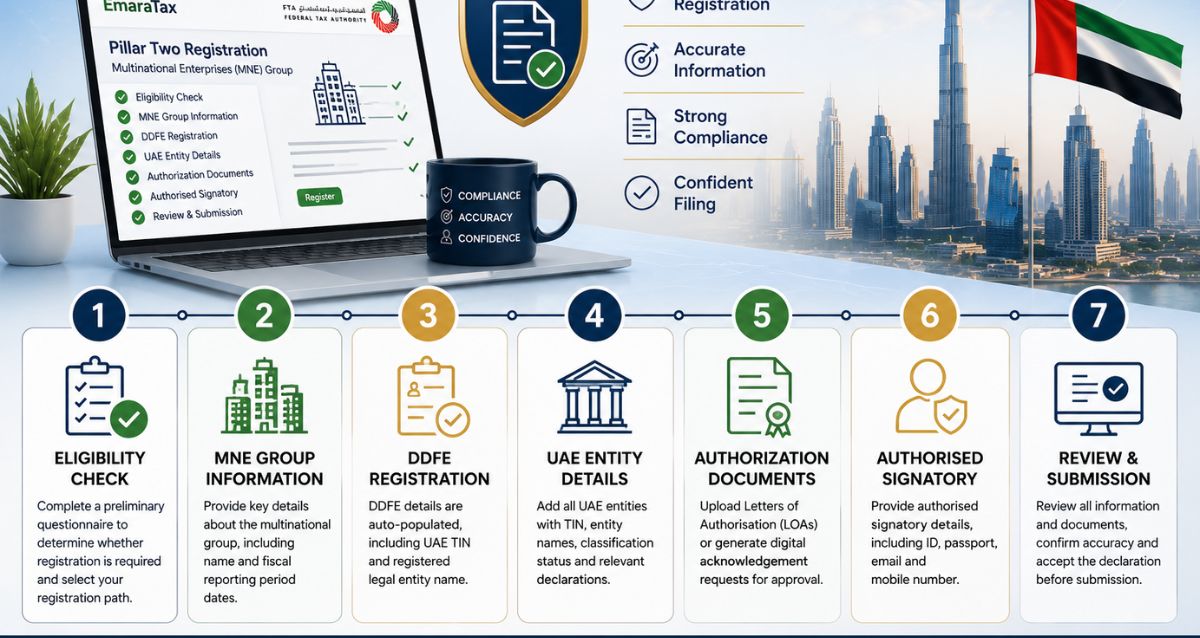
Understanding the 7-Step Registration Process
The FTA has designed the registration journey to be structured and user-friendly. However, businesses should ensure that all required information and supporting documentation are available before initiating the application.
Step 1: Eligibility Questionnaire
The process begins with a preliminary questionnaire that determines whether registration is required.
Applicants will indicate whether they are:
- Registering as an individual constituent entity, or
- Registering as a Domestic Designated Filing Entity (DDFE) on behalf of multiple UAE group entities.
This initial step determines the subsequent registration path.
Step 2: MNE Group Information
The applicant must provide key details about the multinational group, including:
- Official name of the MNE group
- Name as reflected in the consolidated financial statements
- First fiscal reporting period start date
- First fiscal reporting period end date
Accuracy at this stage is critical, as these details form the foundation of the group's Pillar Two registration profile.
Step 3: Domestic Designated Filing Entity (DDFE) Details
For groups electing a DDFE structure, the portal automatically populates:
- UAE Tax Identification Number (TIN)
- Registered legal entity name
The DDFE acts as the principal filing entity for participating UAE group members.
Step 4: UAE Group Entity Details
The applicant must then identify all UAE entities included within the registration.
Information required includes:
- Tax Identification Number (TIN)
- English entity name
- Arabic entity name
- Classification status
Additional declarations may be required where entities are categorised as:
- Permanent Establishments
- Excluded Entities
- Investment Entities
This step requires a comprehensive understanding of the group's UAE structure.
Step 5: Letters of Authorisation (LOA) and Acknowledgements
Where a DDFE is filing on behalf of other group entities, authorisation must be documented.
The portal provides two options:
- Upload signed Letters of Authorisation (LOAs), or
- Generate digital acknowledgement requests for approval by the relevant group entities
Proper authorisation is a critical compliance requirement and should be addressed before commencing registration.
Step 6: Authorised Signatory Details
The details of the authorised signatory responsible for the application must be provided, including:
- Full name
- Emirates ID details
- Passport details
- Email address
- Mobile number
The signatory must possess appropriate authority to represent the entity.
Step 7: Review and Declaration
The final stage presents a complete summary of the application.
Before submission, businesses should:
- Verify all entered information
- Review supporting documents
- Confirm entity listings
- Accept the declaration
Once submitted, the registration request is transmitted to the FTA for processing.
Documents to Prepare Before Registration
To ensure a smooth application process, businesses should have the following readily available:
1. Global Group Structure Chart
A complete organisational chart showing:
- Ultimate Parent Entity
- Intermediate holding companies
- UAE constituent entities
- Ownership relationships
2. Corporate Authorisation Documentation
Signed Letters of Authorisation appointing the designated filing entity or representative responsible for registration and future compliance obligations.
Preparing these documents in advance can significantly reduce delays during the registration process.
Why Early Preparation Matters
Many multinational groups are still assessing the practical impact of Pillar Two on their UAE operations.
However, registration is only the first step.
Businesses must also evaluate:
- Effective tax rate calculations
- Data collection requirements
- Group reporting obligations
- Interaction with the UAE Corporate Tax rules
- Internal governance and compliance procedures
Early preparation allows businesses to identify gaps, align stakeholders, and avoid last-minute compliance challenges.
How Flying Colour Tax Consultants Can Help?
Pillar Two introduces a new layer of complexity for multinational groups operating in the UAE.
At Flying Colour Tax Consultants, our international tax specialists assist businesses with:
Pillar Two Impact Assessments
Determining whether your group falls within the scope of the Global Minimum Tax rules.
Registration Support
Managing the complete EmaraTax registration process, including DDFE registrations and entity mapping.
Group Structure Reviews
Assessing UAE group structures and identifying constituent entities requiring inclusion.
Documentation and Authorization Support
Preparing and reviewing Letters of Authorisation and supporting documentation.
Ongoing Compliance Advisory
Guiding reporting obligations, data requirements, and interaction with the UAE Corporate Tax regulations.
Final Thoughts
The opening of the Pillar Two registration portal marks the beginning of a new compliance era for multinational groups operating in the UAE.
Organisations with global revenues of EUR 750 million or more should not wait until reporting deadlines approach. Early assessment and preparation will be essential to ensure compliance with the UAE's Global Minimum Tax framework.
If your business forms part of a multinational enterprise group, now is the time to evaluate your obligations and establish a clear compliance roadmap.
Flying Colour Tax Consultants is ready to help your organisation navigate the complexities of Pillar Two registration and compliance with confidence.
FAQ
Q1.What is the DMTT rate under the UAE Pillar Two rules?
The Domestic Minimum Top-up Tax rate is a flat 15% - so any in-scope groups making money here need to stump up to meet the OECD required minimum global tax rate on their UAE profits.
Q2.Is there a fixed deadline to register for Pillar Two DMTT?
The FTA has got the EmaraTax registration system open for business, but hasn't actually set a hard registration deadline yet - we do know to expect some guidance, so you'd be best off registering as soon as you can, rather than waiting for the official word.
Q3.What penalties apply for late DMTT registration or filing?
Typically, if you're not up to speed with your DMTT & Pillar Two filings, you will have to follow the UAE Corporate Tax penalty rules. However, the UAE Corporate Tax body has given large groups a special break: no penalties will be levied on DMTT & Pillar Two returns filed by the end of 2026, as long as you demonstrate a genuine effort to do the right thing.
Q4.Does Pillar Two DMTT apply to UAE free zone companies?
Aye, it does. DMTT is applied to the global combined group revenue, even if this group has a UAE free zone entity, and that normally qualifies for a 0% rate.
Q5.How is DMTT different from standard UAE Corporate Tax?
Standard UAE Corporate Tax kicks in at 9%, giving you a fair bit of wriggle room, but DMTT is a flat 15% tax that specifically targets members of large multinational groups. The registration and filing rules for DMTT are on EmaraTax, which is separate from the rest of the Corporate Tax rules.
Q6.Can a tax agent handle DMTT registration on a group's behalf?
YES - businesses can let a tax agent look after the registration and filing for the UAE member entities on their behalf - but to do so, they will need to get an Authorisation Letter signed off by an Authorised Representative, a tax agent or even a Domestic Designated Filing Entity.
Q7.Is my UAE entity in scope if its own local revenue is below EUR 750M?
The EUR 750 million is actually the relevant figure for big groups - it's not just about the UAE entity's individual revenue but whether your whole group has come in above 750m over any two of the last four years - so even if the UAE entity itself is tiny, it could still be in the firing line.
(SSK)*
To learn more about FTA Opens UAE Pillar Two Registration on EmaraTax, book a free consultation with one of the Flyingcolour team advisors.
Disclaimer: The information provided in this blog is based on our understanding of current tax laws and regulations. It is intended for general informational purposes only and does not constitute professional tax advice, consultation, or representation. The author and publisher are not responsible for any errors or omissions, or for any actions taken based on the information contained in this blog.