

Why the FTA Can Decline Your Tax Refund: FTA Decision No. 9 of 2025 Explained
The Tax system in the UAE generally allowed taxpayers to claim back the excess tax paid to the FTA through refund applications. However, as per the newly issued decision, the Federal Tax Authority (FTA) has explicit powers to decline certain tax refund applications if the taxpayer is under audit.
FTA Decision No. 9 of 2025, which is effective from 1st January 2026, details the specific circumstances where FTA can refuse to refund the excess tax amounts while a tax audit is ongoing.
This decision is very important for businesses expecting VAT refunds, Corporate Tax refunds or Excise Tax refunds.
In this article, we explain what is meant by this decision, when FTA can decline a refund request and how businesses can minimise the risk of delay in refunds.
Understanding FTA Decision No. 9 of 2025
The decision, formally titled "The Conditions for Declining the Refund of the Residual Amounts Related to a Refund Request Where the Person is Subject to Tax Audit," was issued on 4th December 2025 and became effective from 1st January 2026.
This decision allows FTA to decline the refund request of residual amounts when a taxpayer is undergoing a tax audit and the existence of certain risk indicators.
This does not mean that every refund request will be rejected during the time of tax audit. Instead, the FTA should have specific reasons to justify withholding of the refund.

Can FTA Reject My Refund in UAE?
The short answer to this question is:
Yes, FTA can decline your refund request if you are under a tax audit and any one of the following conditions exists.
As per this decision, there are six specific conditions where this can happen.
1. Potential Significant Tax Liabilities May Arise
The first condition applies when FTA has sufficient evidence proving that potential tax liabilities may be identified through the ongoing audit.
Example
A company has a VAT refund of AED 500,000*, and they submit a VAT refund application for the same.
During the audit, FTA identified the following:
- There is Potential revenue which is not reported
- Input VAT claims are not supported with adequate documents
- There are some adjustments for Corporate Tax
If these findings could result in significant additional taxes, the FTA can withhold the refund until the completion of audit.
2. Suspected Tax Evasion
The second condition enables FTA to hold the refund application where there are sufficient grounds to believe that the taxpayer may be involved in some tax evasion.
Examples may include:
- Suspicious invoices
- Fake supplier details
- Misleading transactions
- Intentional misstatements in tax returns
When FTA feels like the tax evasion conditions exist, the FTA is unlikely to release refund amounts until the matter is resolved.
3. Suspicion of Tax Evasion Within the Supply Chain
This condition extends beyond the control of the taxpayer itself.
The FTA is empowered to decline a refund request if the refund relates to goods that are suspected of being linked to tax evasion wherever in the supply chain.
Example
A business claims input VAT refunds on goods purchased from suppliers who are suspected to be part of VAT fraud.
Even if the person claiming the refund was not directly involved in the fraud, FTA may withhold the refund until the completion of the investigation.
4. Outstanding Tax Returns
One of the most common reasons for declining a tax refund is failure to submit all required tax returns.
As per this decision, the FTA can decline the refund if the taxpayer has any pending tax returns to be submitted.
This could include:
- VAT returns
- Corporate Tax returns
- Excise Tax returns
Practical Tip
Before going for a refund, verify that all pending filing obligations have been completed.
5. Failure to Provide Requested Information
The FTA can also decline the refund application if the taxpayer fails to provide the requested information during the audit within the stipulated timeframe.
They may request:
- Invoices
- Contracts with clients
- Bank statements
- Accounting records
- Customs data
If there is any delay in making responses to FTA requests, it can directly impact the refund processing.
6. Failure to Cooperate During the Tax Audit
The final condition will be applicable if the taxpayer fails to cooperate with the FTA during the process of audit.
Examples include:
- Refusing access to the records
- Ignoring FTA communications
- Delaying the requested meetings by FTA
- Not allowing the FTA to conduct audit procedures
Cooperation is a key obligation under UAE tax legislation.
Which Refunds Could Be Affected?
The decision applies broadly to tax refunds where the taxpayer is under audit.
Potentially affected refunds may include:
- VAT refunds
- Corporate Tax refunds
- Excise Tax refunds
- Other tax-related residual balances
The actual impact will depend on the taxpayer's circumstances and audit findings.
What Businesses Should Do Before Applying for a Refund
To minimise the risk of a tax refund being declined, businesses should:
Ensure All Tax Returns Are Filed
Confirm that there is no pending VAT, Corporate Tax or Excise Tax returns
Maintain Complete Documentation
Keep all supporting documentation for:
- Input VAT claimed
- Sales transactions
- Customs records
- Tax workings
Respond Promptly to FTA Requests
Complying with deadlines will reduce delays in getting the refund processed.
Review Tax Positions Before Filing
Conduct an internal compliance review before submitting significant refund claims.
Seek Professional Support
It is advisable to seek professional support in case of complex refund cases.
Impact on VAT Refund Claims
Businesses regularly claiming VAT refunds should pay particular attention to this decision.
The industries which commonly going to be affected by this decision include:
- Export businesses
- Real estate developers
- Construction companies
- Manufacturing businesses
- Free Zone entities with excess input VAT
If the refund amounts are substantial, businesses can expect increased scrutiny and prepare all supporting documentation in advance.
Key Takeaways from FTA Decision No. 9 of 2025
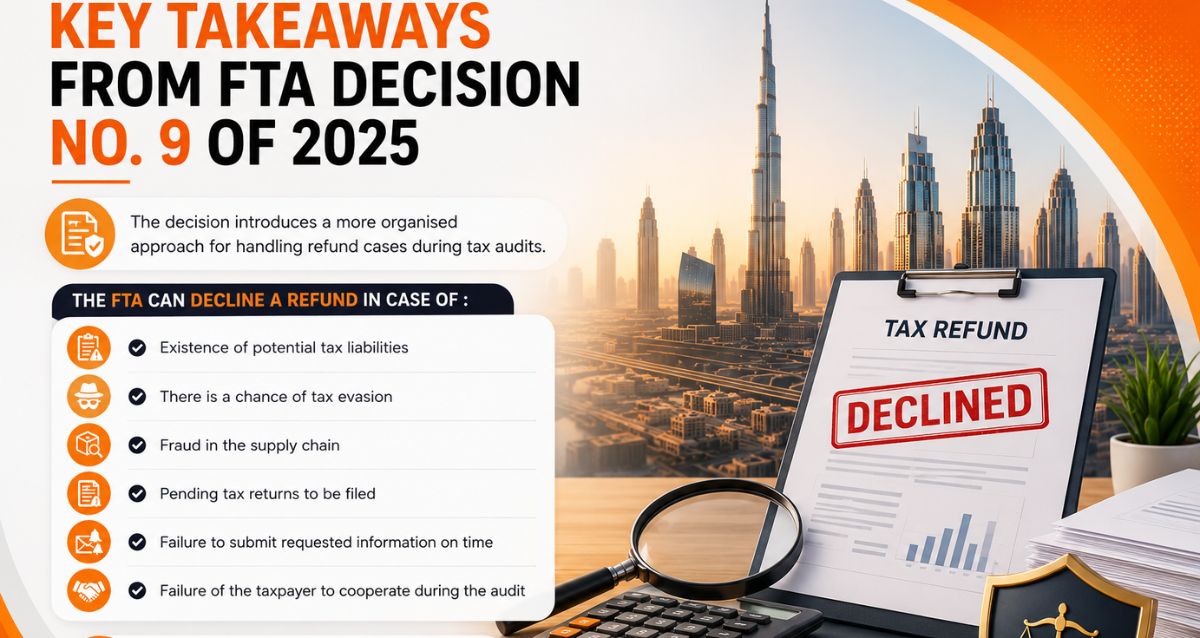
The decision introduces a more organised approach for handling refund cases during tax audits.
The FTA can decline a refund in case of :
✔ Existence of potential tax liabilities
✔ There is a chance of tax evasion
✔ Fraud in the supply chain
✔ Pending tax returns to be filed
✔ Failure to submit requested information on time
✔ Failure of the taxpayer to cooperate during the audit
These provisions become effective from 1 January 2026.
How Can Flying Colour Tax Consultant Help?
At Flying Colour Tax Consultant, we assist businesses with:
- Submission of VAT refund applications
- Corporate Tax compliance reviews
- Support with FTA audit
- Submission of Voluntary disclosures
- Tax health checks
- Review of refund documentation
Our team helps businesses to prepare for audits and maximise the likelihood of successful refund processing while remaining fully compliant with UAE tax laws.
Frequently Asked Questions (FAQs)
1. Can FTA reject my VAT refund during an audit?
Yes. As per the FTA Decision No. 9 of 2025, they can decline a refund request if specific audit-related conditions are not met.
2. Does being under audit automatically mean my refund will be rejected?
No. The FTA must have one or more of the specific grounds mentioned in the decision before declining the refund.
3. Can outstanding Corporate Tax returns affect a VAT refund?
Yes. Any outstanding tax returns with FTA may result in refund being declined.
4. What happens if I do not respond to FTA information requests?
Failure to provide the requested information within the specified timeframe can also lead refund being declined.
5. When does FTA Decision No. 9 of 2025 take effect?
The decision became effective on 1 January 2026.
(FF)*
To learn more about Why FTA Declines Tax Refunds: Decision No. 9/2025, book a free consultation with one of the Flyingcolour team advisors.
Disclaimer: The information provided in this blog is based on our understanding of current tax laws and regulations. It is intended for general informational purposes only and does not constitute professional tax advice, consultation, or representation. The author and publisher are not responsible for any errors or omissions, or for any actions taken based on the information contained in this blog.