


Federal Tax Authority Decision No. 6 of 2026: New Compliance Requirements for Free Zone Distributors Explained
With the introduction of Federal Tax Authority (FTA) Decision No. 6 of 2026, there will be additional compliance requirements for Qualifying Free Zone Persons (QFZPs) engaged in the distribution of goods or materials in or from a Designated Free Zone.
This will be effective for Tax Periods commencing on or after 1 January 2026. Under this decision, businesses claiming the 0% Corporate Tax benefit as qualifying distribution activity would be required to maintain a structured audit and documentation framework to substantiate their eligibility.
For distribution businesses operating from UAE Free Zones, this is one of the most significant compliance requirements since the introduction of the UAE Corporate Tax regime.
What is FTA Decision No. 6 of 2026?
FTA Decision No. 6 of 2026 describes the additional procedures that are to be followed by the Qualifying Free Zone Persons engaged in the distribution of goods or materials in or from a Designated Zone. This is a must to get the Corporate tax benefit for Qualifying Free Zone Persons.
The decision supplements :
- Federal Decree-Law No. 47 of 2022 (Corporate Tax Law)
- Cabinet Decision No. 100 of 2023
- Ministerial Decision No. 229 of 2025
- Ministerial Decision No. 84 of 2025
Who Does This Decision Apply To?
This decision specifically applies to:
- Qualifying Free Zone Persons (QFZPs)
- Businesses that are carrying out the qualifying activity of distribution of goods or materials in or from a Designated Free Zone
Examples include:
- Trading business
- Businesses engaged in import and export
- Wholesale distributors
- Logistics businesses operating in Designated Free Zones
- Supply chain companies serving resellers
If your Free Zone company earns the qualifying income from distribution activities, these additional requirements will be applicable.
What is the Major New Requirement?
The main requirement is to obtain an Agreed-Upon Procedures (AUP) Report from an independent external auditor.
This report should be:
- Prepared by a UAE-licensed independent auditor
- Follow International Standard on Related Services (ISRS) 4400
- Verify that the business is satisfying prescribed conditions for becoming a qualifying activity
This report is not like a traditional audit opinion, unless an AUP report documents factual findings based on agreed testing procedures.
What Must the Auditor Verify?
The auditor must confirm the two key matters:
1. Customers Are Genuine Resellers
The business must be able to prove that its customers:
- Are actually reselling the goods
- Process or alter the goods before reselling or
- Purchase them for qualifying supply.
Supporting documents may include:
- Trade licences
- Commercial licences
- Signed declaration by customers
- Sales contracts
- Purchase orders
- Tax invoices
- Other records for the transaction
2. Goods Entered Through a Designated Zone
If the goods are imported into the UAE, the business should prove that they entered through a Designated Free Zone.
Evidence includes:
- Customs declarations
- Import documentation
- Bills of lading
- Airway bills
- Shipping documents
- Logistics records
What Documentation Should Businesses Maintain?
The final decision depends highly on documentation.
Businesses should maintain:
Customer Documentation
- Valid trade licences of the customers
- Business licences
- Declarations from customers
- Confirmation from resellers
Commercial Records
- Sales Contracts
- Purchase orders
- Tax invoices
Import Documentation
- Customs declarations
- Shipping documents
- Import permits
Internal Records
- Records of inventory
- Warehouse reports
- Logs on movement of goods
- Documentation for logistics
New Agreed-Upon Procedures (AUP)
The decision detailing specific testing procedures that the auditor should perform
These include:
Customer Verification
The auditor is required to verify customer licences to determine whether their activities indicate genuine resale operations.
Customer Declarations
Signed confirmations from customers are required to be verified to prove that the goods are purchased for resale purposes.
Sales Agreement Review
The auditor reviews the agreements and invoices to determine whether the transactions indicate onward sale or resale.
Import Verification
Documents relating to import is reviewed to confirm that the goods entered the UAE through a Designated Zone.
Internal Logistics Review
Records of Inventory movements and details of warehouse and logistics records are examined to support the importation process.
Sample Selection Rules
The decision also introduces a prescribed methodology for stamping.
The auditor should select samples based on:
- Total customer count
- Number of sales contracts
- Number of imports
The sample must include the highest-value transactions during the relevant tax period with a prescribed 10% margin of error methodology.
Submission Deadline
The Agreed-Upon Procedures Report must be submitted to the FTA within 30 days after the Corporate Tax return filing deadline unless the FTA specifies any other date.
Hence, it is required for businesses to coordinate with their auditors well before the filing deadline.
What Happens If You Do Not Submit the Report?
Failure to submit the AUP report will result in serious consequences.
The conditions for the qualifying distribution activity will be considered as not satisfied. It will affect the eligibility of 0% Corporate tax for qualifying free zone persons.
This will result in paying the standard UAE Corporate Tax rate on the affected income.
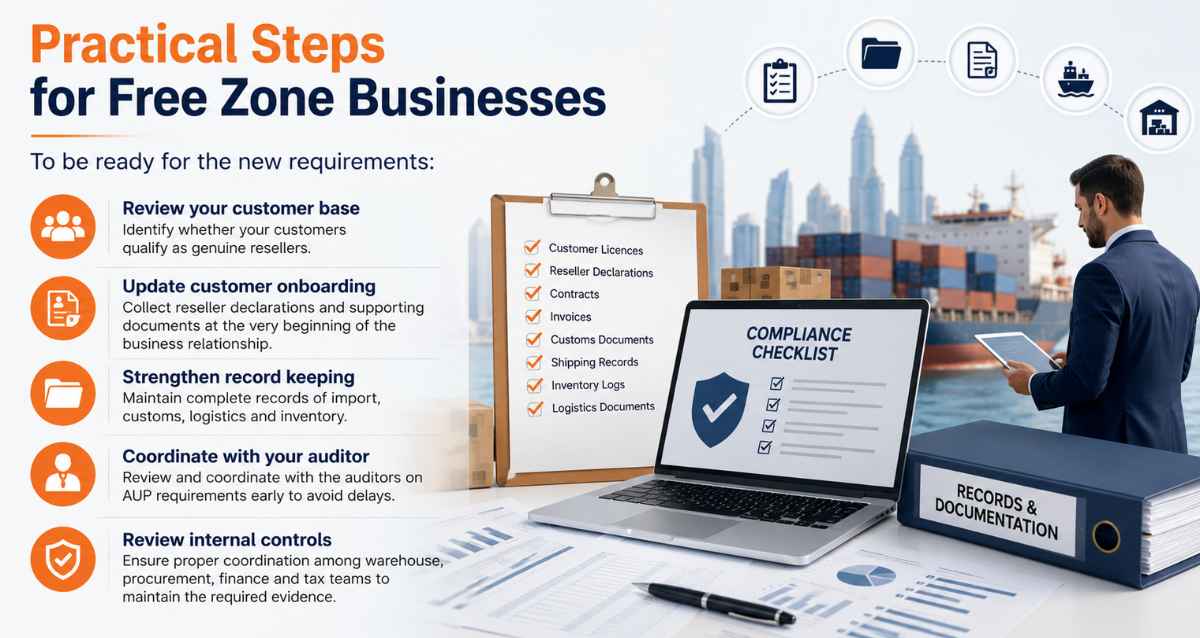
Practical Steps for Free Zone Businesses
To be ready for the new requirements:
✔ Review your customer base
Identify whether your customers qualify as genuine resellers.
✔ Update customer onboarding
Collect reseller declarations and supporting documents at the very beginning of the business relationship.
✔ Strengthen record keeping
Maintain complete records of import, customs, logistics and inventory.
✔ Coordinate with your auditor
Review and coordinate with the auditors on AUP requirements early to avoid delays.
✔ Review internal controls
Ensure proper coordination among warehouse, procurement, finance and tax teams to maintain the required evidence.
Why This Decision Matters
The FTA now requires businesses to maintain proper evidence supporting their eligibility for 0% Corporate Tax regime.
This reflects a broader trend towards :
- Increased transparency
- Strong and detailed documentation
- Risk-based compliance
- Enhanced audit readiness
Businesses that prepare early will be in a much stronger position during future Corporate Tax audits.
How Can Flying Colour Tax Consultant Help?
At Flying Colour Tax Consultant, we assist businesses with:
- Assessment of Qualifying Free Zone Person (QFZP) eligibility
- Review of Corporate tax compliance
- Documentation readiness for distribution businesses
- Coordination with external auditors for Agreed-Upon Procedures (AUP) reports
- Preparation and filing of Corporate tax return
- FTA audit support and advisory
Our experienced tax professionals help Free Zone businesses to navigate evolving UAE Corporate Tax requirements while maintaining compliance and protecting valuable tax incentives.
Frequently Asked Questions (FAQs)
1. What is FTA Decision No. 6 of 2026?
This is a new FTA decision that introduces additional compliance procedures for Qualifying Free Zone Persons engaged in the distribution of goods or materials in or from a Designated Zone to get the benefit of 0% Corporate tax.
2. Who needs to obtain an Agreed-Upon Procedures Report?
Qualifying Free Zone Persons carrying out the qualifying distribution activity covered by the decision must obtain the AUP report from an independent auditor licensed in the UAE.
3. What documents should businesses retain?
Businesses should maintain documents like customer licences, reseller declarations, contracts, invoices, customs documents, shipping records, inventory logs and logistics documentation.
4. When must the report be submitted?
The AUP report should be submitted within 30 days from the Corporate Tax return filing deadline, unless the FTA determines otherwise.
5. What happens if the report is not submitted?
Failure to submit the report means the businesses violated the conditions for the relevant qualifying activity, which may affect the eligibility for the 0% Corporate Tax regime.
(FF*)
To learn more about FTA Decision No. 6 of 2026: Free Zone Compliance, book a free consultation with one of the Flyingcolour team advisors.
Disclaimer: The information provided in this blog is based on our understanding of current tax laws and regulations. It is intended for general informational purposes only and does not constitute professional tax advice, consultation, or representation. The author and publisher are not responsible for any errors or omissions, or for any actions taken based on the information contained in this blog.