

Family Foundation UAE: 7 Corporate Tax Updates for 2026
The Federal Tax Authority (FTA) released an updated version of the Corporate Tax Guide in June 2026, covering the Taxation of Family Foundations in the UAE, replacing the original version issued in May 2025.
For families who prefer foundations, trusts and holding structures to protect the assets and manage their wealth, the question is simple:
"What is the actual change, and does it affect my structure?"
This blog details the seven key updates in simple language, along with examples, so you can quickly understand what is new and where more attention is needed.
A Quick Reminder: What Is a Family Foundation?
A Family Foundation is not a separate legal entity type in the UAE. It is a structure under the Corporate Tax Law. A foundation, trust or similar entity can qualify as a Family Foundation if it satisfies the conditions of Article 17 of the Corporate Tax Law.
Once it qualifies, it can make an application to FTA to be treated as a transparent Unincorporated Partnership. Upon getting the benefit of tax transparency, the foundation itself is not required to pay any Corporate Tax. Instead, the income is treated as income of beneficiaries, which will fall under out of scope for UAE Corporate Tax.
The updated guide details how these rules apply. According to FTA, the amended sections are 2.5, 3.3, 3.4, 6, 7.8, 7.9, and 7.10. Here explains what they mean.
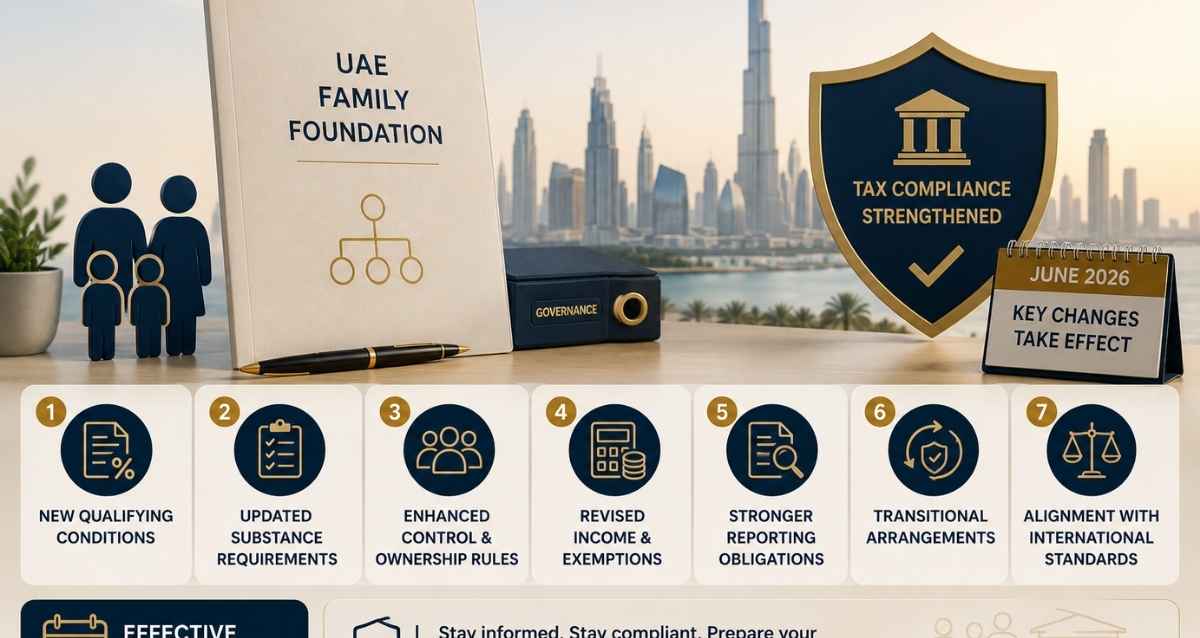
1. Companies Owned by More Than One Family Foundation Can Now Be Transparent
This is the most important update.
As per the old guide, a holding company is to be treated as tax transparent if it is wholly owned and controlled by a single Family Foundation.
Under the new guide, a holding company can also qualify for tax transparency if it is owned jointly by two or more Family Foundations, as long as they own together 100% and one of them controls the company.
Example: A SPV which is owned 80% by Family Foundation 1 and 20% by Family Foundation 2. Under the old regulations, this SPV could not be treated as transparent because it was not owned by a single foundation. As per the new rules, the combined ownership will be treated as "wholly owned," hence the SPV is eligible for tax transparency.
This helps the families to pool the investments across more than one foundation.
2. An LLC Is Not a Family Foundation by Itself
The updated guide gives an important clarification. A Limited Liability Company (LLC) is not a "similar entity", and therefore, it cannot be treated as a Family Foundation on its own.
However, an LLC can still get the benefit of tax transparency if it is wholly owned and controlled by a tax-transparent Family Foundation. Through a multi-tier structure only, the LLC can apply for tax transparency, not by applying directly as a Family Foundation.
In short, the LLC cannot be self - qualified as tax transparent, but it can take benefit on the transparency of the Family Foundation holding it.
3. Be Careful When Moving Assets Into a Family Foundation
The new guide gives clear guidance on how to make transfers into a Family Foundation.
If a company transfers its assets into a Family Foundation, the company is a taxable person and must report any capital gain on that transfer. Where the transfer is between the related parties, it must be carried out at market value (the arm's length price), so it is not possible for you to simply use a low book value to reduce the capital gain.
Example: A company holds a property which is recorded in its books at AED 3 million. The market value at the time of transfer is AED 8 million. The company should recognise a taxable gain of AED 5 million (8 million - 3 million), which is then subject to Corporate Tax.
Practical point: The tax treatment is different for an individual. Where a natural person transfers his personal investment, such as their personal shareholding in a company, this will not fall under the scope of Corporate Tax. So in many cases, moving your shares from a company into the foundation can be more tax efficient than moving the underlying assets out of the company. The correct approach always depends on specific requirements, hence this should be reviewed before doing any transfer.
4. Family Offices (SFO and MFO) Are Treated as a Business
The guide now covers specific guidance on Single Family Offices (SFO) and Multi Family Offices (MFO).
A family office is treated as an operating business because it provides management services, usually for a fee. That is why it generally cannot meet the conditions to become tax transparent and will end up in paying like any other business.
There is one exception to the above. If the family office qualifies as a Qualifying Free Zone Person and meets all the required conditions, including regulatory oversight by a competent authority such as the UAE Central Bank, the DFSA or the FSRA, it can take the benefit of 0% Corporate Tax on its qualifying income. If it only holds a licence without any regulatory oversight, it will not get 0% Corporate tax benefit.
5. Moving In and Out of Transparency Does Not Reset Asset Cost
The new guide brings an important rule for companies that change their transparency status.
A company may shift from taxable status to transparent (when it becomes part of a Family Foundation structure) and later back to a taxable person (when it leaves the structure). During his shift, the base cost of its assets does not reset. The years they spent as a transparent entity are getting simply ignored for cost purposes.
Example: A company buys a building of value AED 10 million. It then becomes tax transparent for two years, and later becomes taxable again. At the time of final sale of this building, the cost for tax purposes is still remains AED 10 million. The transparent period does not add value. The gain on sale is calculated from the original value of AED 10 million.
This prevents the usage of these structures to artificially wash out a taxable gain.
6. The Beneficiary Condition Flows Down to Subsidiaries
The updated guide gives a helpful clarification on the beneficiary condition.
If the Family Foundation itself meets the beneficiary condition, that is, if it was set up for an identified or identifiable natural person or for a public benefit entity, then any company that is wholly owned and controlled by the Family Foundation is automatically treated as meeting that condition too.
This removes uncertainty on whether each company under the structure needs its own separate beneficiaries. As long as the foundation at the top is qualified, the companies below the structure are considered to serve the same purpose.
7. Foreign Partnerships Do Not Need to Register
Finally, the guide clarifies on a registration point. A Foreign Partnership that is fiscally transparent is not required to register for Corporate Tax.
This concept is different from a Family Foundation that is transparent by default, such as an unincorporated trust, which still should register for Corporate Tax even though it does not pay any tax in its own right.
Summary of the Key Changes
|
Change |
What it means |
|
Joint Ownership |
A company owned by two or more family foundations can now get the benefit of tax transparency |
|
LLC Status |
An LLC cannot be a Family Foundation by itself, but can get the transparency status if wholly owned by a foundation |
|
Asset Transfers |
A company transferring its assets to a foundation must recognise the gain at market value |
|
Family offices |
SFOs and MFOs are treated as taxable businesses, and will get the benefit of 0% corporate tax only if they qualify as a QFZP |
|
No cost reset |
The cost of an asset will not change when a company moves in and out of transparency |
|
Beneficiary Condition |
A qualifying foundation passes its beneficiary condition down to its subsidiaries |
|
Foreign Partnerships |
There is no registration requirement for a transparent Foreign Partnership; a default transparent Family foundation still does |
Practical Takeaways for UAE Families
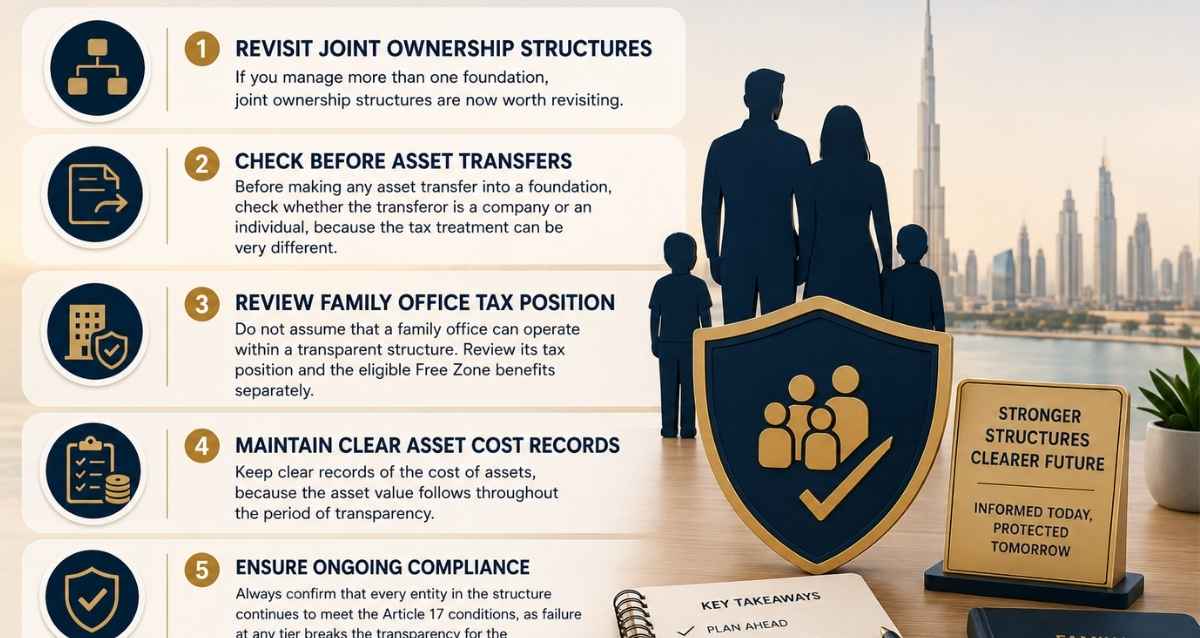
- If you manage more than one foundation, joint ownership structures are now worth revisiting.
- Before making any asset transfer into a foundation, check whether the transferor is a company or an individual, because the tax treatment can be very different.
- Do not assume that a family office can operate within a transparent structure. Review its tax position and the eligible Free Zone benefits separately.
- Keep clear records of the cost of assets, because the asset value follows throughout the period of transparency.
- Always confirm that every entity in the structure continues to meet the Article 17 conditions, as failure at any tier breaks the transparency for the entities below it.
Conclusion
The June 2026 update by FTA on the Family Foundations guide does not change the main regime, but it provides more detailed and valuable clarifications and also one significant relaxation on joint ownership. For families using structures like foundations, trusts and holding companies, these updates affect how the structures should be designed, how assets should be transferred and how family offices should be positioned.
Because the outcome always depends on the specific facts of each structure, it is important to review your position against the updated guidance before making any changes.
How Flying Colour Tax Can Help You?
Flyingcolour Tax Consultant provides expert advisory on Family Foundation structures and Corporate Tax applicability in the UAE, including:
- Reviewing whether your foundation, trust or company meets the conditions of Article 17
- Designing and reviewing multi-tier and multi-foundation ownership structures
- Advising on asset transfers into foundations, covering arm's length and transfer pricing requirements
- Advising on Corporate Tax position of Single and Multi-Family Offices
- Handling the compliances like Corporate Tax registration, transparency applications and annual declarations
To understand how these changes may apply to your structure, you can book a free consultation with the Flyingcolour team advisors.
Frequently Asked Questions (FAQs)
1. What is a Family Foundation under UAE Corporate Tax?
The structure of a foundation, trust or similar entity that meets the conditions of Article 17 of the Corporate Tax Law. Once it qualifies, it can make an application to be treated as fiscally transparent, resulting in no Corporate tax liability on its own.
2. Can a company owned by two Family Foundations be tax transparent now?
Yes. Under the new guide issued in June 2026, a company can be wholly owned jointly by two or more Family Foundations and still qualify as tax transparent, provided it also meets the other conditions.
3. Will I pay tax if I move my company shares into a foundation?
If you are a natural person transferring the personal shareholding into a foundation, this is usually outside the purview of UAE Corporate Tax. However, if a company transfers the assets, it should recognise a taxable gain at market value. The outcome depends on the facts and should be reviewed in advance.
4. Can a family office be tax transparent?
Generally, no, because a family office is considered an operating business. It may get the benefit of 0% tax rate only if it qualifies as a Qualifying Free Zone Person with the required regulatory oversight.
5. Does a transparent Family Foundation still need to register for Corporate Tax?
Yes. A Family Foundation that is transparent by default must still need to register, even though it does not have any tax liability on it’s own. A transparent Foreign Partnership, however, does not need to register.
Disclaimer: The information provided in this blog is based on our understanding of the current tax laws, regulations, and the FTA Corporate Tax Guide on Family Foundations (CTGFF1). It is intended for general informational purposes only and does not constitute professional tax advice, consultation, or representation. The author and publisher are not responsible for any errors or omissions, or for any actions taken based on the information contained in this blog. Each structure should be reviewed based on its specific facts and circumstances.
To learn more about UAE Family Foundations: 7 Corporate Tax Changes June 2026, book a free consultation with one of the Flyingcolour team advisors.
Disclaimer: The information provided in this blog is based on our understanding of current tax laws and regulations. It is intended for general informational purposes only and does not constitute professional tax advice, consultation, or representation. The author and publisher are not responsible for any errors or omissions, or for any actions taken based on the information contained in this blog.