

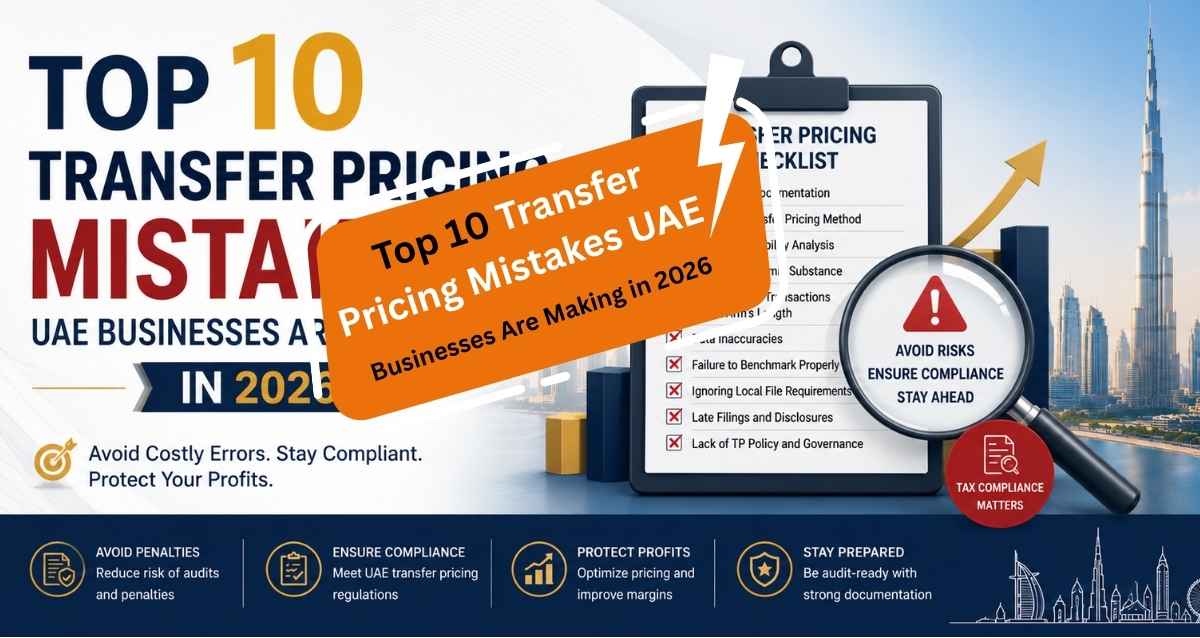
Transfer Pricing Mistakes UAE 2026
While the UAE’s Corporate Tax structure is getting more defined, the Transfer Pricing (TP) compliance is also getting into the light as a major requirement. Since most of the business entities have understood the basic requirements of the UAE Corporate Tax, transfer pricing is still a nightmare for most of them. The reason is that it has not been properly understood.
The UAE’s Transfer Pricing regulations are in alignment with the OECD guidelines, and as per its requirement, businesses must explain that the transactions between the related parties and the connected persons are conducted at arm’s length principle. Failure to abide by the regulations will attract penalties and tax audits from the FTA as well.
In this article, let us discuss the top 10 mistakes made by UAE businesses while working on the Transfer Pricing requirements in 2026.
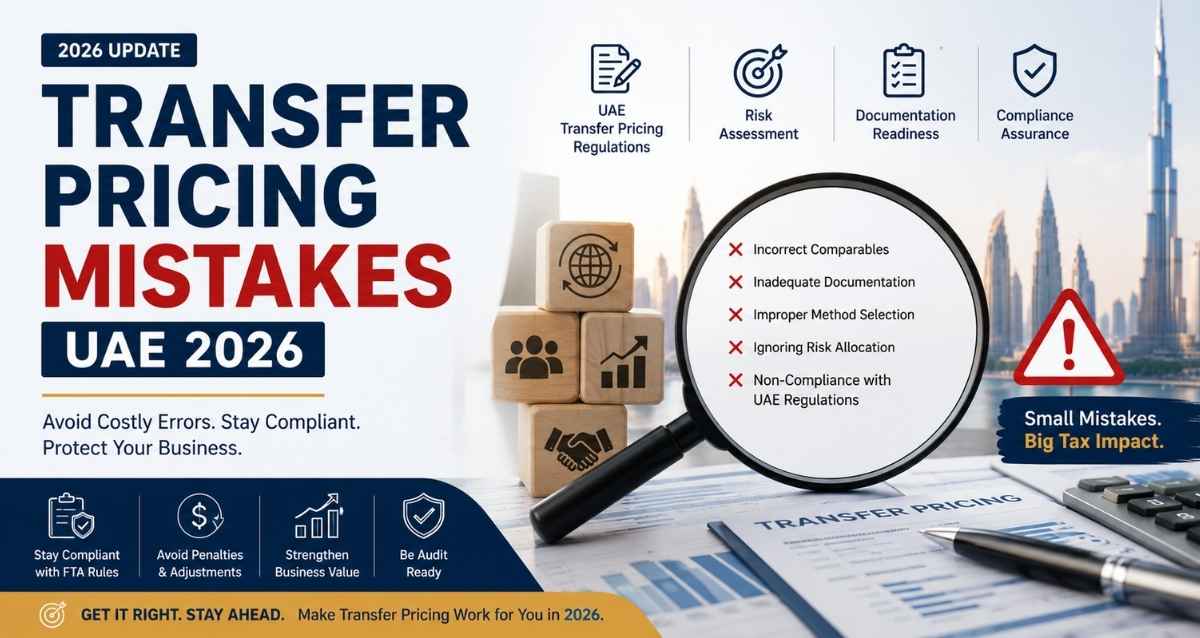
1. Assuming Transfer Pricing Only Applies to Large Multinational Companies
This is one of the most commonly misunderstood requirements. Transfer pricing is just not the requirement for MNE’s, it is mandatory for any UAE entity that deals with connected persons and related party transactions. Including the small-sized entities which has annual turnover of less than 3M AED, family-owned businesses and local group structures.
How to avoid it:
Ensure that your financials are reviewed every year by the Tax Experts to understand the transactions and to determine the requirement of Transfer Pricing applicability.
2. Failing to Identify All Related Party Transactions
We often see that businesses focus only on the transactions between the parent and the subsidiary and misses on the transactions between the related parties.
Some examples of the related party and connected person transactions are as follows:
- Management fees
- Director remuneration
- Shareholder loans
- Intercompany services
- Rent charged between related entities
- Intellectual property licensing
How to avoid it:
Ensure that you maintain a related party transaction register and update it on a regular basis.
3. Not Maintaining Proper Transfer Pricing Documentation
Many business entities assume that they can internally prepare the documentation if requested by the FTA. This can create a serious compliance risk. FTA may request supporting Transfer Pricing documentation to prove that the transactions have been done at Arm’s Length during their reviews and audits.
How to avoid it:
Ensure that the Transfer Pricing documentation is well prepared and maintained during the year, rather than after receiving an inquiry from the FTA. Also, need to ensure that it has been prepared and evaluated by a Transfer Pricing expert.
4. Using Arbitrary Pricing Methods
We also come across some companies that determine their intercompany transactions based on their convenience rather than the economic analysis.
Some examples include:
- Flat management fees
- Unsupported markups
- Estimated cost allocations
- Informal pricing arrangements
Let us remember that without supporting evidence, these methods may not satisfy arm's length requirements.
How to avoid it:
Proper application of recognised Transfer Pricing methodologies with supporting benchmarking and economic analysis is mandatory.
5. Ignoring Shareholder and Connected Person Transactions
This is a common mistake that most of the businesses make. They mainly focus on the corporate group transactions, but overlook the payments made to the shareholders, directors, and connected persons.
We should make a note that the FTA focuses special attention on the transactions that are artificially made to reduce the taxable profits of the company.
How to avoid it:
It is mandatory that all the transactions relating to the shareholders' compensation, benefits, and service arrangements involving connected persons are evaluated in order to ensure they are as per the market norms.
6. Treating Transfer Pricing as a Year-End Exercise
Keeping the Transfer Pricing assessment as a last-minute activity will only complicate the situation, rather than planning on the tax requirement.
How to avoid it:
It is recommended that we integrate the Transfer Pricing reviews as a part of the quarterly financial reporting and tax governance processes.
7. Lack of Benchmarking Studies

Though we now understand that benchmarking is a critical component of demonstrating arm's length pricing. We still find that many businesses rely on their internal assumptions without external market evidence.
This is a threat and can weaken their position during an FTA review.
How to avoid it:
Ensure that you conduct regular benchmarking updates based on the reliable market data and update them as and when the business circumstances change.
8. Overlooking Cross-Border Transactions
Let us be reminded that the cross-border transactions always attract more validation when compared to the in-country transactions, the reason being that they can directly affect taxable profits in multiple jurisdictions across the globe.
Some of the common examples of cross-border transactions are:
- Intercompany loans
- Shared service arrangements
- Technology licensing
- Regional management services
How to avoid it:
Ensure that you assess all the international transactions from a Transfer Pricing perspective and maintain supporting documentation that can be provided when requested by the FTA.
9. Inconsistent Financial Records and TP Documentation
This is the basic findings of the FTA on their audits, as to why the Transfer Pricing documentation figures do not match the financial statements.
This can be a result of differences in transaction values, descriptions, or reporting periods, which can raise concerns.
How to avoid it:
Ensure that the accounting records, tax returns, and Transfer Pricing documentation are fully reconciled before filing. These will be the supporting documents of evidence when asked for.
10. Waiting for an FTA Audit Before Taking Action
Some businesses assume they can work on the Transfer Pricing issues only if the FTA contacts them.
This reactive approach can increase compliance risks and reduce the ability to defend positions effectively.
How to avoid it:
Conduct proactive Transfer Pricing health checks and periodic risk assessments.
Key Takeaways for UAE Businesses
Let us understand that transfer pricing is no longer a compliance issue that businesses can afford to ignore/push to a later stage. Companies should expect increased regulatory focus on related-party transactions and supporting documentation on a proactive approach rather than being reactive.
To reduce risk in 2026, businesses should:
- Identify all related-party transactions
- Maintain accurate documentation
- Conduct benchmarking studies
- Review connected person arrangements
- Align Transfer Pricing policies with OECD principles
- Perform regular compliance reviews
Taking a proactive approach today can help businesses avoid costly adjustments, penalties, and disputes in the future.
Need Assistance with Transfer Pricing Compliance?
Our tax specialists help UAE businesses assess Transfer Pricing risks, prepare documentation, conduct benchmarking studies, and ensure compliance with UAE Corporate Tax regulations.
Contact our team today to schedule a Transfer Pricing health check and stay audit-ready in 2026.
FAQs: People Also Ask
Q1. What is Transfer Pricing in UAE Corporate Tax?
Transfer Pricing in the UAE refers to the rules that require businesses to price transactions between related parties and connected persons at arm's length, meaning the price must reflect what two independent parties would agree upon in an open market. These rules are governed by the UAE Corporate Tax Law (Federal Decree-Law No. 47 of 2022) and are aligned with OECD guidelines.
Q2. Does Transfer Pricing apply to small businesses in the UAE?
Yes. Transfer Pricing is not limited to large multinational companies. Any UAE business, including SMEs, family-owned companies, and local group structures, that conducts transactions with related parties or connected persons is subject to Transfer Pricing rules, regardless of annual turnover size.
Q3. What documents are required for Transfer Pricing compliance in the UAE?
UAE businesses must maintain a Master File, Local File, and a Disclosure Form as part of their Transfer Pricing documentation. These documents must demonstrate that all related-party transactions are conducted at arm's length and should be prepared proactively, not only when the FTA requests them.
Q4. What is the arm's length principle in UAE Transfer Pricing?
The arm's length principle requires that the price charged in a transaction between related parties must be the same as what two unrelated, independent parties would agree upon under similar circumstances. The FTA uses this standard to evaluate whether intercompany transactions are commercially justified or designed to reduce taxable profits.
Q5. What are the penalties for Transfer Pricing non-compliance in the UAE?
Businesses that fail to comply with the UAE's Transfer Pricing requirements may face FTA tax audits, adjustments to taxable income, and administrative penalties as outlined in Cabinet Decision No. 75 of 2023. Penalties can also arise from failure to maintain proper documentation, incorrect tax return filings, and non-disclosure of related-party transactions.
Q6. What is benchmarking in Transfer Pricing, and why is it important?
Benchmarking is the process of comparing a company's intercompany transaction prices against market data from comparable independent transactions. It is a critical component of proving arm's length pricing to the FTA. Without updated benchmarking studies supported by reliable market data, a business's Transfer Pricing position is difficult to defend during an audit.
Q7. How often should UAE businesses review their Transfer Pricing policies?
UAE businesses should review their Transfer Pricing policies at least annually, ideally as part of their quarterly financial reporting and tax governance process. Business changes such as new intercompany arrangements, restructuring, or changes in market conditions should trigger an immediate Transfer Pricing review rather than waiting until year-end or an FTA audit.
To learn more about Top 10 Transfer Pricing Mistakes UAE Businesses Are Making in 2026, book a free consultation with one of the Flyingcolour team advisors.
Disclaimer: The information provided in this blog is based on our understanding of current tax laws and regulations. It is intended for general informational purposes only and does not constitute professional tax advice, consultation, or representation. The author and publisher are not responsible for any errors or omissions, or for any actions taken based on the information contained in this blog.