

GIBAN UAE VAT Payment: Step-by-Step Guide
The UAE has introduced a modernised tax payment system via GIBAN (Generated International Bank Account Number). If you are a VAT-registered business, it is very important to understand how to use GIBAN correctly to avoid delay in payments, reconciliation matters and potential penalties.
Many businesses still use credit card payments or alternative channels without realising that GIBAN offers a direct and cost-effective way to settle their VAT liabilities with the Federal Tax Authority (FTA).
In this guide, we explain in detail what GIBAN is, how it works, where it can be found in the EmaraTax portal and how to pay VAT using GIBAN in the UAE.
What is GIBAN?
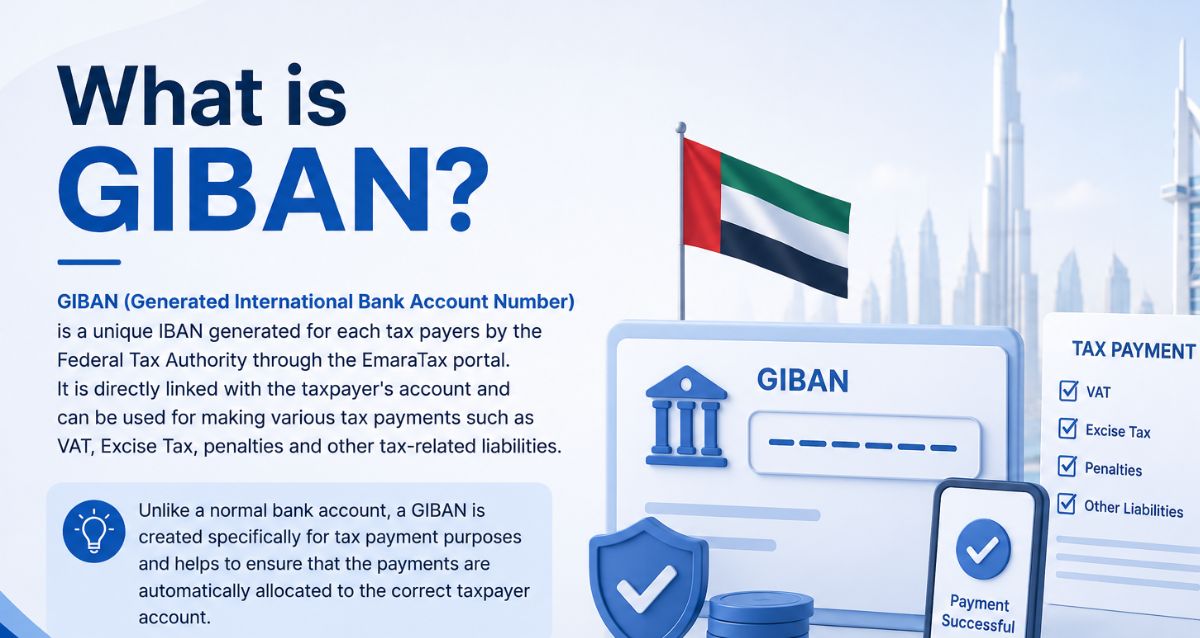
GIBAN (Generated International Bank Account Number) is a unique IBAN generated for each taxpayer by the Federal Tax Authority through the EmaraTax portal. It is directly linked with the taxpayer's account and can be used for making various tax payments such as VAT, Excise Tax, penalties and other tax-related liabilities.
Unlike a normal bank account, a GIBAN is created specifically for tax payment purposes and helps to ensure that the payments are automatically allocated to the correct taxpayer account.
Why Did the FTA Introduce GIBAN?
Before the introduction of GIBAN, the tax payments were made by the businesses to general FTA accounts, which sometimes resulted in reconciliation delays and issues with payment allocation.
The GIBAN system was introduced to:
- Improve the accuracy of payment
- Minimise the allocation errors
- Speed up the payment process
- Facilitate digital tax compliances
- Link payments directly to a particular taxpayer's account
This enables FTA to identify the taxpayer and liability more efficiently.
Who Receives a GIBAN?
Every business registered for VAT will receive a unique GIBAN automatically after getting the VAT registration approved.
There is no need to apply separately for a GIBAN.
Once your VAT registration is activated in the FTA portal, the system generates your GIBAN automatically.
How to Find Your GIBAN in EmaraTax
Finding your GIBAN in the Emaratax portal is very easy.
Step 1: Log in to EmaraTax
Log in to your FTA account using your credentials or UAE pass.
Step 2: Open Your VAT Account
Click on the VAT tab under your tax profile.
Step 3: View Payment Details
The account will display your allotted GIBAN under your VAT registration details.
Step 4: Verify Tax Type
If you are registered for multiple taxes, such as VAT, Corporate Tax and Excise Tax, you may have separate GIBANs for each tax type. Ensure to use the correct one.
How to Pay VAT Using GIBAN
The common question is :
"How to pay VAT using GIBAN?"
The process is comparatively simple.
Step 1: File Your VAT Return
Submit your VAT return first with the FTA portal, before proceeding with payment.
After submission, your tax liability will automatically be calculated by the system and generate a payment instruction.
Step 2: Obtain Payment Reference Number (PRN).
The EmaraTax portal generates a Payment Reference Number (PRN) along with payment instructions. This reference number is essential for the proper allocation of funds.
Step 3: Initiate Bank Transfer
Log in to your online banking portal and enter the FTA payment details received along with your assigned GIBAN.
Step 4: Enter the Correct Amount
Transfer the exact amount due for payment as per the FTA calculation.
Step 5: Include Reference Information
Ensure the Payment Reference Number is correctly included in the payment details wherever required by your bank.
Step 6: Retain Payment Confirmation
Keep a copy of the transfer receipt for your records.
Benefits of GIBAN VAT Payment
There are several advantages on using GIBAN for payments :
Faster Payment Processing
Payments are directly linked to the taxpayer's account, thereby reducing manual intervention and errors
Improved Accuracy
The risk of payment allocation errors can be significantly reduced.
Secure Transactions
Payments are more secure as they are processed through regulated banking channels.
Cost Savings
While some other payment gateways charge a processing fee, GIBAN transfers often avoid the same.
Better Audit Trail
It is easy for businesses to track and verify their tax payments.
Common Mistakes Businesses Make When Using GIBAN
Paying Before Filing the VAT Return
Some businesses make a transfer of funds before submitting their VAT return.
Without submitting, the payment may remain unallocated until the liability is generated.
Using the Wrong GIBAN
Those businesses registered for multiple tax types with FTA may wrongly use the incorrect GIBAN.
Entering Incorrect Payment References
Failure to enter the correct PRN may result in a delay in the allocation of the payment.
Waiting Until the Last Day
Some of the businesses wait until the due date to make the payment. Bank processing times can vary depending on each bank, and late payments may attract penalties.
Can Non-Resident Businesses Use GIBAN?
Yes. Non-resident companies that are registered for VAT in the UAE can also use GIBAN to make their tax payments through international bank transfers.
But such payments may require:
- SWIFT transfer instructions
- Correct details of the beneficiary
- Sufficient time to process the payment
There is a chance that International transfers can take several business days to reflect in the FTA account.
How Long Does GIBAN Payment Take?
The processing time for GIBAN payment depends on the payment method.
UAE Bank Transfers
If the taxpayer's bank account is in the UAE, it will typically be processed within 24 hours.
International Transfers
May take 3 to 5 business days, depending on the transferor bank and jurisdiction.
Businesses need to initiate payments before the VAT due date.
What Happens If You Pay Late?
Late payment of VAT may result in administrative penalties and interest charges under the UAE tax regulations.
Therefore, it is important for the businesses to :
- Ensure VAT return filing on time
- Initiate payments without delay
- Monitor the payment status to reflect in the EmaraTax portal
Proper planning will help you to avoid unnecessary compliance burden.
Best Practices for GIBAN VAT Payment
To ensure smooth compliance with VAT:
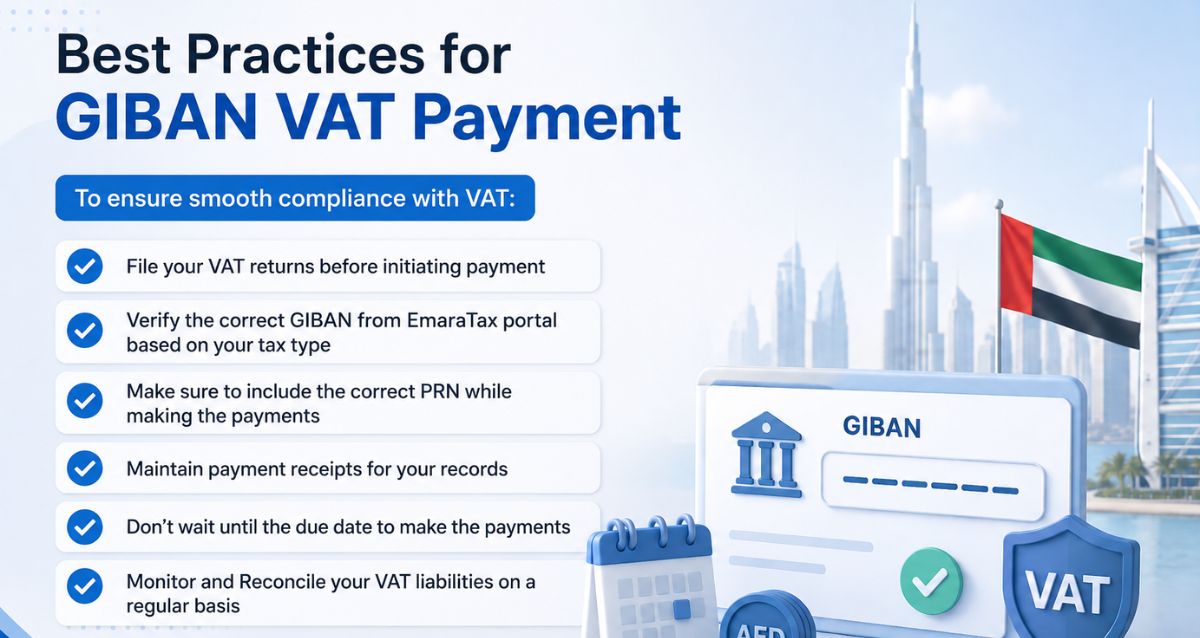
✔ File your VAT returns before initiating payment
✔ Verify the correct GIBAN from the EmaraTax portal based on your tax type
✔ Make sure to include the correct PRN while making the payments
✔ Maintain payment receipts for your records
✔ Don’t wait until the due date to make the payments
✔ Monitor and reconcile your VAT liabilities regularly
How Can Flyingcolour Tax Consultants Help You?
Navigating UAE tax compliance has just gotten a lot trickier - & it's not getting any easier any time soon.
Whether you're wrestling with GIBAN for VAT obligations, trying to keep FTA audit red flags to a minimum in your business records, setting up a Family Foundation in line with the latest 2026 Corporate Tax Guide, or getting a Free Zone company set up with the right compliance framework from day one, the stakes of getting it wrong have never been higher.
At Flyingcolour Tax Consultants, we're here to help businesses across the UAE with:
VAT Compliance & Payments
We cover everything from VAT registration through to filing returns and getting the right GIBAN payments set up on EmaraTax, so you know that your VAT obligations are all in order and getting paid on time - so there's no chance of mismatched returns or allocation errors getting your business into hot water with the FTA.
Corporate Tax Registration & Advisory
Corporate Tax is still a bit of a grey area for a lot of businesses. We take a close look at your set-up, make sure you're registered with the right bits with the Federal Tax Authority, and help you build the documentation that'll keep you on the right side of things if the FTA ever comes calling.
FTA Audit Preparedness
If your VAT returns aren't matching up with your books, or you're missing documents and can't track down related-party transactions, you're already open to an FTA audit. We do proactive compliance reviews so we can find any issues and fix them before you even get a notice.
Family Foundation & Wealth Structuring
The FTA's updated Corporate Tax Guide has just introduced a load more clarity on multi-tier ownership, asset transfers and family office treatment under Article 17. We help HNW individuals and family offices figure out if their set-up qualifies for tax transparency, and what needs to be in place to keep it that way.
Free Zone & Mainland Structuring
Just because you're in a Free Zone doesn't mean you're off the hook compliance-wise. We help international founders pick the right structure, sort out Corporate Tax registration, and get an AML compliance framework set up from scratch - so you don't have to go back and rebuild later, when it always costs a lot more.
AML Compliance Setup
If you're in a regulated sector or doing things that need to be reported as part of Relevant Activities, AML obligations are very much still in effect. We take care of the registration, compliance officer requirements, and ongoing documentation so you're always on the right side of the regulator.
Frequently Asked Questions (FAQs)
1. What is GIBAN in the UAE?
GIBAN stands for Generated International Bank Account Number. It is a unique payment account allocated to each taxpayer based on the tax type by the FTA.
2. Is GIBAN the same as a normal bank account?
No. GIBAN is not the same as a normal bank account. It is specifically created for particular tax payments only
3. How do I find my GIBAN in EmaraTax?
You can find your GIBAN by logging into the EmaraTax portal and clicking on your VAT account details.
4. Can I pay VAT from outside the UAE using GIBAN?
Yes. Non-resident businesses can also use GIBAN for transferring the VAT payments.
5. Do I need to file the VAT return before paying through GIBAN?
Yes. You need to file the VAT return first to ensure that the liability is generated correctly and the payment will be properly allocated by FTA.
Conclusion
VAT payments in the UAE become simpler, more efficient and secure with the introduction of the GIBAN system. Every VAT-registered business in the UAE should understand how to use GIBAN correctly to avoid delays in payments and allocation issues.
Businesses can ensure compliance with tax and can reduce the risk of penalties by filing VAT returns on time, using the correct GIBAN for payments and by following the payment instructions as per FTA.
If your business requires assistance in VAT registration, VAT return filing, VAT payments or EmaraTax compliance, we are here to give you professional guidance.
(FF)*
To learn more about GIBAN in UAE: The Complete Guide to Paying VAT via GIBAN (2026), book a free consultation with one of the Flyingcolour team advisors.
Disclaimer: The information provided in this blog is based on our understanding of current tax laws and regulations. It is intended for general informational purposes only and does not constitute professional tax advice, consultation, or representation. The author and publisher are not responsible for any errors or omissions, or for any actions taken based on the information contained in this blog.