

UAE E-Invoicing Deadline 30 October 2026
The UAE is moving towards a digital invoicing system that will change how businesses issue, exchange and report invoices. Under the UAE e-invoicing framework, businesses will need to move beyond traditional PDF invoices and adopt a structured electronic system that allows invoice data to be processed and exchanged electronically.
For businesses with annual revenue of AED 50 million or more, an important deadline is approaching. The Federal Tax Authority (FTA) has confirmed that businesses within this category must appoint an Accredited Service Provider (ASP) by 30 October 2026 and implement the UAE e-invoicing system by 1 January 2027. The appointment deadline was extended from 31 July 2026, while the implementation date remains unchanged.
Businesses should therefore start evaluating their existing accounting software, invoicing processes and technology requirements rather than waiting until the deadline approaches.
What Is UAE E-Invoicing?
UAE e-invoicing is a system for issuing, exchanging and reporting invoice data in a structured electronic format. It is designed to allow business systems to communicate with each other and report relevant tax data to the FTA through approved service providers.
A conventional invoice may be prepared in accounting software and emailed to a customer as a PDF. Although the document is electronic, it is not necessarily an e-invoice under the UAE framework.
An e-invoice contains structured data that can be read and processed automatically by compatible systems.
The UAE model uses the Peppol framework and a decentralised exchange mechanism involving the supplier, the supplier's service provider, the buyer's service provider and the buyer. Relevant tax data is also reported to the FTA.
The objective is to reduce manual invoice processing, improve data accuracy, support tax compliance and make business transactions easier to exchange electronically.
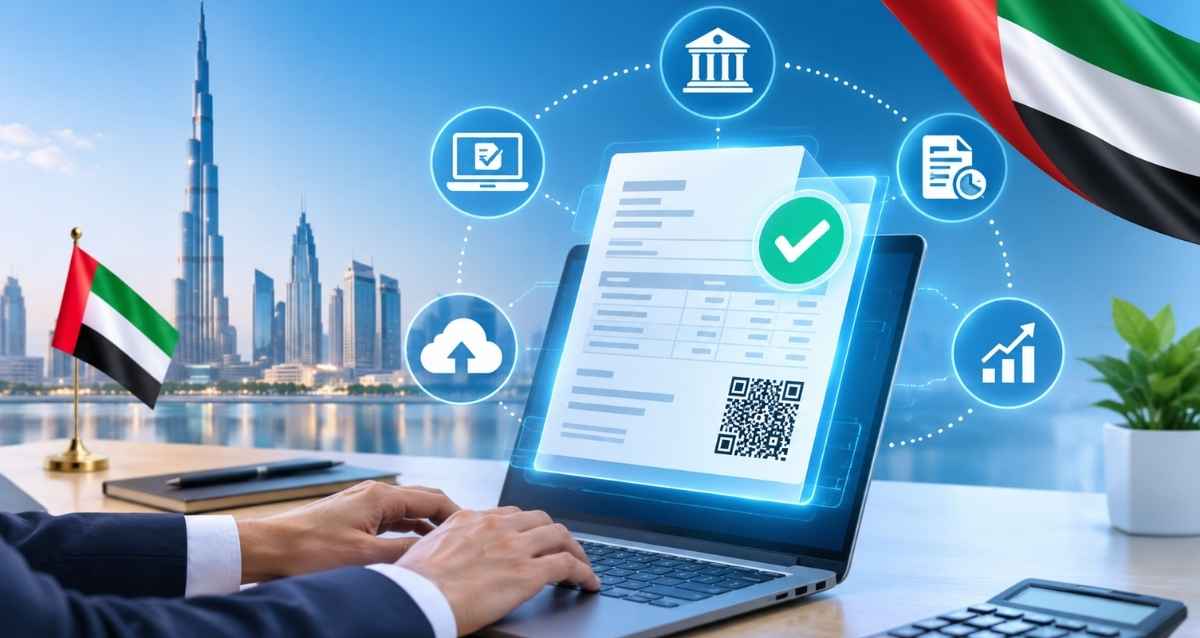
UAE E-Invoicing Deadline 2026: What Businesses Must Know
The UAE e-invoicing implementation timeline is being introduced in phases based on revenue and entity type.
The following dates apply to the principal implementation phases announced by the FTA.
|
Business category |
Deadline to appoint an ASP |
Implementation deadline |
|
Businesses with revenue of AED 50 million or more |
30 October 2026 |
1 January 2027 |
|
Businesses with revenue below AED 50 million |
31 March 2027 |
1 July 2027 |
|
Government entities |
31 March 2027 |
1 October 2027 |
These deadlines reflect the published implementation timetable, including the extension for businesses with revenue of AED 50 million or more.
It is important to distinguish between two obligations:
· ASP appointment deadline: The date by which the business must appoint its service provider.
· Implementation deadline: The date by which the business must have implemented the e-invoicing system.
Appointing an ASP does not automatically mean that the business is ready to go live. Software integration, data validation, testing and onboarding must also be completed.
Who Must Appoint an Accredited E-Invoicing Service Provider in the UAE?
Businesses falling within the relevant mandatory phase must appoint an ASP to connect their invoicing systems to the UAE e-invoicing network.
For the first phase, businesses with annual revenue equal to or exceeding AED 50 million must appoint their provider by 30 October 2026.
The revenue assessment should be based on the applicable e-invoicing rules. The Ministry of Finance's published rollout information refers to the latest financial statements for existing businesses and projected revenue for the current financial year for newly established businesses. Companies should review their position carefully rather than relying only on VAT registration status or a single VAT return.
Businesses should also confirm whether their transactions fall within the scope of the e-invoicing requirements. The framework is not limited simply to the question of whether a company is VAT-registered.
Business-to-consumer (B2C) transactions are currently treated separately under the published framework. Businesses dealing with both businesses and individual consumers should review their transaction types and applicable exclusions before deciding which invoices must be processed through the system.
What Is an Accredited Service Provider?
An Accredited Service Provider is a service provider authorised under the UAE e-invoicing framework to support businesses with electronic invoice exchange and the related technical requirements.
The provider connects the business's invoicing or accounting system to the e-invoicing network and helps ensure that invoice data follows the required technical standards.
Depending on the solution selected, the provider may support:
- Electronic invoice generation and data conversion.
- Validation of invoice information and mandatory fields.
- Secure transmission of e-invoices.
- Exchange of invoices between suppliers and customers.
- Reporting of relevant tax data to the FTA.
- Integration with existing accounting or enterprise resource planning (ERP) software.
- Technical support, error handling and transaction status monitoring.
Businesses should select a provider based on its official accreditation status, technical compatibility, service quality, pricing and ability to support their transaction volumes.
The Ministry of Finance maintains official information about service provider accreditation and the e-invoicing framework.

What to do before 30 October 2026
The date is closer than most people think. And remember, 30 October is only the deadline to appoint your ASP. You go live on 1 January 2027. So don’t treat it as the finish line. It’s where the real work starts.
This is the order I’d follow.
First, check if it applies to you
Get your latest financial statements and see which phase you fall into. If your company is new, read the rules on projected revenue, because they may apply. Then list your legal entities and the kinds of transactions you do. If you have a group of companies, it’s easy to miss one.
Then look at your accounting software
Can it connect to an ASP? Many businesses just assume it can. Don’t assume. Look for missing invoice fields, untidy customer and supplier records, wrong tax codes, and anything else that could block the connection.
Choose the ASP
Check accreditation first. After that, look at compatibility, price, transaction limits, setup help, and the support you get after go-live. The cheapest option is often not the cheapest. If it doesn’t work with your software, you’ll pay for that somewhere else.
Write down how invoices move in your company
Who prepares them? Who approves them? How are they sent, received and recorded? Don’t forget purchase invoices and credit notes. Most people only think about sales invoices.
Clean your data
Check customer and supplier names, tax registration numbers, addresses, payment terms, product descriptions and VAT codes. Small mistakes here can make invoices fail validation.
Plan testing, and share the work
Sit down with your ASP and software provider and agree how data will be mapped, set up and tested. Put finance, IT and operations on it together. If only one person knows how it works and they go on leave, you have a problem.
Finish onboarding and keep your records
Complete the onboarding steps, including the ones on EmaraTax. Keep everything: why you chose the provider, the agreements, test results, training, and project dates.
Mistakes we see (or expect to see)
Most of these come from one thing: people think e-invoicing is a software install. It isn’t.
- Choosing an ASP in the last few weeks.
- Assuming the current software will just work.
- Thinking a PDF is an e-invoice. It isn’t.
- Skipping the data clean-up.
- Expecting the ASP to fix VAT mistakes. It won’t.
- Forgetting purchase invoices.
- Having no one in charge of the project.
If you only fix one thing, fix your data. Good systems can’t help with bad information.
How Flying Colour Tax Consultant can help
Flyingcolour Tax Consultant help UAE businesses get ready for e-invoicing. In practice, that means:
- Checking which timeline applies to you
- Reviewing how you invoice and do your accounting today
- Looking at your invoice data and VAT controls
- Working with your software provider and ASP
- Helping you plan the setup
- Reviewing how you handle validation, credit notes and record-keeping
FAQ
1. What is the UAE e-invoicing deadline for businesses that rake in AED 50 million or more?
Businesses bringing in an annual revenue of AED 50 million or more have to sign up with an Accredited Service Provider by the 30th of October 2026 at the latest and get their UAE e-invoicing system up and running by January 1st, 2027. And just so you know that deadline got bumped out to the 30th of October from the 31st of July this year.
2. What is UAE e-invoicing all about?
UAE e-invoicing is a neat system for sending, swapping and recording invoice data in a tidy, electronic format. It lets all the different business systems talk to one another and report on relevant tax info to the FTA through some approved service providers.
3. Is sending a customer a PDF invoice the same as sending an e-invoice in the UAE?
No, a PDF is electronic, but sending one to a customer isn't exactly the same as sending an e-invoice under the UAE rules. An e-invoice has got to contain the right sort of data that can be read and processed automatically by compatible systems.
4. What's the deal with Accredited Service Providers (ASPs)?
An ASP is basically a provider that's been green-lit under the UAE e-invoicing framework. It connects up a business's invoicing or accounting system to the e-invoicing network, makes sure the invoice data is all valid, sends out e-invoices on your behalf, and helps with reporting tax data to the FTA.
5. When do smaller businesses need to get their e-invoicing up and running?
Businesses that bring in less than AED 50 million a year have got to sign up with an ASP by the 31st of March 2027 and make the switch to e-invoicing by the 1st of July 2027. And for government entities, it's the same appointment deadline, but they get a bit extra time - until the 1st of October 2027 - to get their e-invoicing system live.
6. Does that 30th of October 2026 deadline mean my business has got to be fully live with e-invoicing right from the start?
Nope, that 30th of October 2026 deadline is just the point when businesses with revenue of AED 50 million or more need to have signed up with an ASP - it doesn't mean the business needs to be fully up and running with e-invoicing just yet. There's still time for integration, testing and all the rest before the go-live date of January 1st 2027.
7. How do they decide whether a business meets that AED 50 million revenue threshold?
Existing businesses can use their latest financial statements, and newly established businesses can use their projected revenue for the current year. One tip: don't assume you can just go by the VAT registration status of your business - make sure you review the numbers carefully.
8. Are invoices to individuals covered by the UAE e-invoicing rules?
For now, B2C transactions are being treated a bit separately under the UAE framework. Businesses that deal with both companies and individual customers should probably take a closer look at which invoices need to be processed through the e-invoicing system and which ones don't.
9. How do I go about choosing an Accredited Service Provider?
First off, check that they're officially accredited. Then compare the different service providers out there on factors like software compatibility, pricing, what kind of transactions they can handle, setup help, and how well they'll support you after you've gone live - don't just go for the cheapest option, or it might end up costing you more in the long run.
10. What should businesses do before the 30th of October 2026?
First off, work out which phase of the e-invoicing rollout applies to your business - then check that your accounting software is compatible with an ASP, map out your invoice workflows (including purchase invoices and credit notes), clean up any dodgy customer, supplier and VAT data, and then finally, pick an accredited provider and start planning for the testing phase.(SSK)
To learn more about UAE E-Invoicing Deadline 30 October 2026: A Complete Business Guide, book a free consultation with one of the Flyingcolour team advisors.
Disclaimer: The information provided in this blog is based on our understanding of current tax laws and regulations. It is intended for general informational purposes only and does not constitute professional tax advice, consultation, or representation. The author and publisher are not responsible for any errors or omissions, or for any actions taken based on the information contained in this blog.