

UAE FTA Decision No. 4 of 2026: New Rules for Maintaining Accounting Records and Commercial Books
The Federal Tax Authority (FTA) has introduced Decision No. 4 of 2026, which sets out specific rules and requirements for maintaining accounting records and commercial books for businesses in the UAE. The Decision was issued on 2nd June 2026 and became effective from 30th July 2026.
This new requirement is particularly relevant for businesses maintaining records electronically, using scanned copy documents, cloud accounting systems, outsourcing the bookkeeping or third-party record-keeping arrangements.
What Does FTA Decision No. 4 of 2026 Cover?
The Decision establishes how the accounting records and commercial books must be maintained, including the use of electronic copies and photocopies.
An "Electronic Copy" means a document or record, saved or converted into an electronic format that can be viewed, retrieved and read via electronic systems or media. A "Photocopy" includes a copy of the records produced through photocopying, scanning or photographic reproduction that preserves the form and content of the original document clearly and legibly.
This is very important because maintaining a digital copy of a document does not simply mean scanning any portion of the document which the business considers relevant. The FTA has prescribed specific standards.
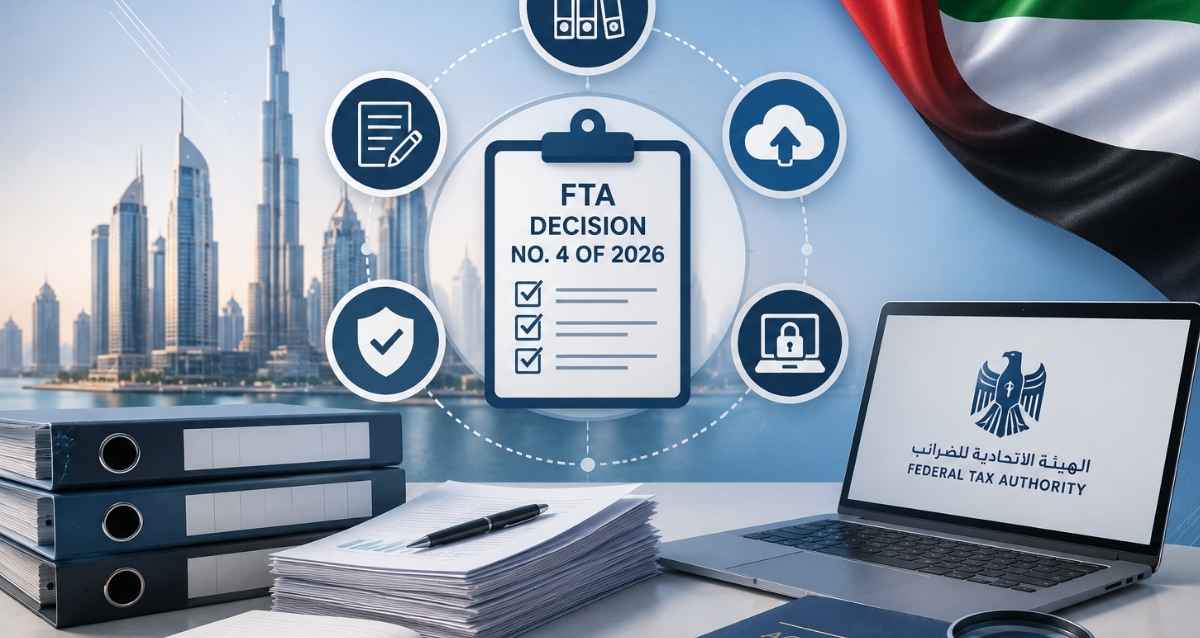
1. Records Must Be Complete and Identical to the Original
As per Article 2, accounting records and commercial books should
- Be complete and same as to the original records
- Be clear and easily readable
- Be accessible to FTA as and when they request, including access to the system in which the records are being stored.
What does this mean for businesses?
It is required for businesses to make sure that their accounting and document-management system keeps the original information without any alteration or omission.
For example, if an invoice contains several pages, keeping only the first page may not satisfy the requirements where the complete document is necessary.
2. Partial Scanning Is Not Accepted
One of the most important requirements is that an electronic copy or photocopy must have all pages in the same order as the original document.
The FTA specifically mentioned that partial scanning of any part of the document is not accepted.
This means it is required for businesses to review their existing document-scanning procedures.
For example, if a contract contains:
1. Cover page
2. Commercial terms
3. Terms of services
4. Pricing details
5. Signed acceptance page
retaining only the signed page may not be sufficient where the entire document forms part of accounting or commercial record.
3. Digital Copies Must Be Clear and Legible
Electronic copies and photocopies should have sufficient quality and resolution so that the information contained in the original document remains clear and easily readable.
The Decision particularly requires that electronic copies or photocopies must be clearly legible when displayed on a computer screen.
For physical photocopies, businesses must ensure the quality of ink and paper and it should not fade during the record-keeping period.
Interestingly, the Decision also permits a non-coloured photocopy of a coloured document, provided that the underlying data and details remain clearly legible.
4. FTA Must Be Able to Access the Records
Maintaining records is not just storing them. Instead, it should also be accessible to FTA when requested.
Where the electronic records or the systems containing them are password protected or encrypted, the business must also provide the necessary passwords or encryption keys to enable FTA to access the records.
For photocopies, access must also be available to the stored documents, including the locations where they it stored.
Practical implication
Businesses should not wait until the FTA audit to determine whether their finance team can retrieve historical records.
A proper document-retention method will enable the business to quickly locate and produce relevant
- Invoices
- Accounting records
- Commercial books
- Supporting documents
- Scanned documents
- Electronic records
· Other records maintained for tax and accounting purposes
5. Can Businesses Outsource Record Keeping?
Yes.
Under Article 4, a business can engage a third party to maintain its accounting records and commercial books. However, outsourcing the same does not transfer the legal responsibility.
The business remains legally responsible for maintaining the records and ensuring their safety.
This is particularly relevant for companies using
- Outsourcing accounting services to third parties
- Bookkeeping service providers
- Cloud accounting softwares
- Document-management providers
- Group shared-service centres
The key point
Outsourcing record keeping does not mean outsourcing compliance responsibility.
If the third-party provider misses the documents, cannot retrieve records or maintains incomplete copies, the business may still face compliance consequences.
What Should UAE Businesses Do Now?
FTA Decision No. 4 of 2026 provides an opportunity for businesses to review their record-keeping systems and identify weaknesses before FTA comes for inspection or tax audit.
Businesses should consider implementing the following checklist:
1. Review your document retention policy
Confirm what all accounting and commercial records are being maintained and whether the retention process ensures the capture of complete original documents.
2. Audit your scanned documents
Check whether the documents are being completely scanned and whether all the pages are maintained in the correct order.
3. Check document quality
Ensure scanned documents and photocopies remain clear and readable when retrieved.
4. Test your retrieval process
Select historical records and check whether your team can retrieve them easily.
5. Review access controls
If records are protected by passwords or encryption, establish a proper procedure for providing access when it is required legally.
6. Review third-party arrangements
If the business has outsourced bookkeeping or document retention, review the service agreement and confirm who is responsible for storage, security, backups and retrieval of data.
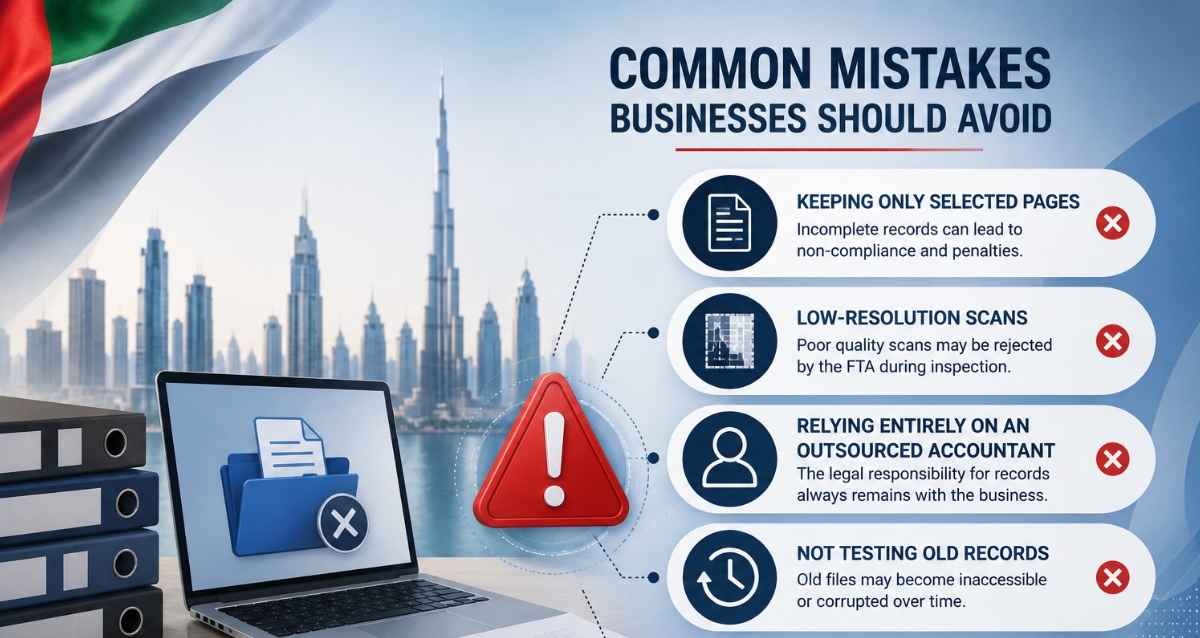
Common Mistakes Businesses Should Avoid
Keeping only selected pages: The FTA requires the electronic copies and photocopies to include all pages in the same order as the original documents
Low-resolution scans: Documents that cannot be clearly readable on a computer screen may create compliance problems.
Relying entirely on an outsourced accountant: The business remains legally responsible even where a third party maintains the records.
Not testing old records: A company may believe that the records are properly stored until it finds that older documents cannot be opened or retrieved.
Losing access to encrypted systems: Businesses need to maintain appropriate access arrangements for documents protected by passwords or encryption.
How Does This Affect FTA Tax Audits?
Proper record keeping is an important part of tax compliance because, in some cases, FTA may need access to the accounting and commercial information when reviewing a taxpayer's transactions.
Therefore, businesses should ensure document retention is more important than an administrative accounting function. It is part of their broader tax compliance framework.
5 FAQs on FTA Decision No. 4 of 2026
1. When did FTA Decision No. 4 of 2026 become effective?
The Decision was issued on 02nd June 2026, and it comes into effect from its date of publication in the Official Gazette. The document identifies 30th July 2026 as its effective date.
2. Can UAE businesses maintain accounting records electronically?
Yes. Businesses can maintain electronic copies, provided they meet the prescribed requirements, including being identical to the original document, complete, clear and legible.
3. Is partial scanning of an invoice or document acceptable?
No. The Decision specifically requires that partial scanning of any part of the document be unacceptable. Electronic copies and photocopies should also include all pages in the same order as the original records.
4. Can a company appoint an accounting service provider to maintain its records?
Yes. A business may engage a third party to maintain its accounting records and commercial books. However, the business remains legally responsible for maintaining those records and ensuring their safety.
5. What happens if electronic records are password protected?
Where electronic records or the systems containing them are protected by encryption or passwords, the necessary encryption keys or passwords should be provided to the FTA to access the records as and when requested.
Conclusion
FTA Decision No. 4 of 2026 sets out clear standards on how UAE businesses should retain their accounting records and commercial books, particularly where documents are stored electronically or as photocopies.
The primary requirement is that records must be complete, identical to the original, clear, legible and accessible to FTA when requested.
Businesses should therefore review their accounting systems, document-scanning procedures, storage arrangements, and third-party bookkeeping contracts to ensure that their records meet the new legal requirements.
To learn more about UAE FTA Decision No. 4 of 2026: Accounting Records Rules, book a free consultation with one of the Flyingcolour team advisors.
Disclaimer: The information provided in this blog is based on our understanding of current tax laws and regulations. It is intended for general informational purposes only and does not constitute professional tax advice, consultation, or representation. The author and publisher are not responsible for any errors or omissions, or for any actions taken based on the information contained in this blog.