

UAE VAT Input Tax Verification: FTA Decision No. 13 of 2026
From 1st October 2026, UAE businesses will be required to verify the validity and integrity of supplies before claiming input VAT.
The Federal Tax Authority (FTA) has issued Federal Tax Authority Decision No. 13 of 2026, titled Measures, Procedures and Conditions required by Taxable Persons for the Verification of the Validity and Integrity of the Supplies before Deduction of Input Tax.
This new rule is particularly important for businesses with significant purchase volumes, high-value supplies, complex supply chains, or transactions involving higher-risk suppliers.
This blog explains the key requirements under FTA Decision No. 13 of 2026 and what businesses should do before the implementation of the new rule.
What Is FTA Decision No. 13 of 2026?
FTA Decision No. 13 of 2026 explains the measures, procedures and conditions a Taxable Person should follow while verifying the validity and integrity of supplies received before deducting input tax.
In short, businesses is required to carry out certain checks on supplies and maintain evidence proving that those checks were performed.
The Decision will come into effect on:
1st October 2026
Therefore, it is required for businesses to review their procurement transactions, accounts payable and VAT processes before this date.
Why Is Supplier Verification Important for Input Tax Recovery?
Recovery of input tax is an important part of UAE VAT compliance.
However, the new decision emphasises the responsibility of a taxable Person to verify the genuineness and integrity of supplies before claiming input tax.
Rather than keeping the supplier invoice only as a compliance document, businesses should consider :
-
Who is the supplier
-
Whether the supply actually happened
-
Where the supplier is operating
-
How the payment was made
-
Whether the pricing is reasonable
-
Whether the goods are genuine or not
-
Whether the supplier is eligible to sell the goods
-
Where there are any indicators of potential Tax Evasion.
What Supplier Checks Are Required?
The decision mentions several steps for verification of the supplier.
1. Verify the Supplier's Identity
The requirement for verification depends on whether the supplier is a natural person or a legal person.
Where the supplier is a natural person
He/she should :
- Obtain a copy of valid identification documents like Emirates ID or passport and
- Arrange a meeting with the supplier either in person or virtually before making the supply
Where the supplier is a legal person
The Taxable Person must:
- Verify the supplier's incorporation documents through official databases or obtain a certificate of incorporation/License
- Ensure that the incorporation details are valid and match the entity's name, address, and other relevant information
- Verify the identity of the director, manager or employee authorised to represent the supplier by obtaining valid identification.
2. Verify the Supplier's Business Address
Businesses should also verify the address and place of business of suppliers.
The Taxable Person must verify that the supplier has an actual place of business.
This can be carried out through :
- Proper electronic means or
- A field visit to the supplier's place of business
The business should also consider whether the supplier's premises are compatible with the nature of activities it is conducting.
3. Assess Supplier Risk Indicators
The decision mentions the specific indicators that businesses should consider while assessing supplier risk.
A Taxable Person should ensure that the following indicators do not apply to:
Frequent address changes
The supplier changed their address more than twice during the previous 12 months.
Frequent changes in key employees
The supplier has changed main employees, including managers or directors with whom the Taxable Person deals, more than twice during the previous 12 months.
4. Bank Account Verification for Higher-Value Suppliers
An additional requirement of bank account verification applies where the value of supplies received from a supplier
- Exceeds AED 375,000 during the preceding 12 months, or
- Is expected to exceed AED 375,000 in the next 12 months.
In such cases, the Taxable Person should verify that the supplier has a bank account.
The business must also obtain a written confirmation from an authorised bank in the UAE confirming that the supplier has a bank account.
There is no need for the bank confirmation to contain relevant reservations or conditions.
The Decision states that the confirmation does not have to be issued directly to the recipient of the supply.
Review of Client Recommendations and Public Information
For supplies exceeding the AED 375,000 threshold, the Taxable Person must also review and assess the available details like
- Reviews
- Website
- Other relevant information
from reliable sources.
The objective is to determine whether the information is consistent with the supplier's
- Business nature
- Size of business
- Commercial activity
The business should also check whether there is any indicators of suspected Tax Evasion.
Verification of the Supply Itself
Supplier verification is only a part of new requirements.
Businesses must also verify the supply received.
It involves several checks
1. Assess the Commercial Purpose of the Transaction
The Taxable Person must also conduct a general assessment of supply and its transactions.
The business must ensure that the involvement of the supplier is based on genuine commercial reasons.
In short, the businesses should be in a position to explain why the transaction occurred and why the supplier was engaged.
2. Review Payment Conditions
The payment methods must also be justifiable.
The business should review:
- The payment method
- Payment terms
- Whether there is any involvement of a third party in making or receiving payment
- Whether payment is made to a bank account outside the country of incorporation of the supplier
Where there are unusual payment arrangements, the Taxable Person should possess a reasonable commercial explanation that matches with available evidence.
Electronic Payments Are the General Expectation
The Decision specifically states that consideration for supply should be paid in electronic means.
Where payment is made in cash, the business should have
- A valid reason documented
- Compliance with prescribed thresholds under tax regulations
- An easily verifiable payment arrangement
3. Check Whether the Pricing Is Commercially Reasonable
The Taxable Person must ensure that the price or profit margin is
- Commercially justifiable
- Significantly matching market conditions
This does not mean all transactions must have identical market prices.
However, where the pricing is found unusual, the business must be able to explain and document the commercial reason behind it.
4. Check the Supplier's Licensed Activities
Businesses should verify that the goods or services received do not fall outside the scope of supplier's:
- Normal business activities or
- Activities permitted under their commercial license.
Example
If a company having management consultancy service as their licensed activity suddenly supplies large quantities of food products, the purchaser should monitor whether any additional verification is required.
5. Verify the Authenticity and Origin of Goods
Where the supplies involve goods, the Taxable Person should verify:
- The authenticity of the goods
- Origin of supply
- The supplier's ownership of the goods
- The supplier's legal right to dispose of the goods.
This requirement will be applicable for the businesses involving:
- Goods with high value
- Trading activity
- Wholesale trade
- Import and distribution of goods
- Electronics supply
- Luxury products supply
- Other supply chains where ownership and authenticity may be important.
What If the Supplier Is an Intermediary?
In transactions where the supplier acts as an intermediary, the Taxable Person should verify that there is a clear and justifiable commercial explanation for the role of supplier.
Whether there is an involvement of multiple parties, contracts, purchase orders, delivery records and payment documents become more important.
How Often Must Supplier Verification Be Performed?
A Taxable Person must verify a supplier
When dealing with the supplier for the first time
or
When dealing with an existing supplier where the supplier has not been verified during the previous 12 months.
This means it is required for businesses to establish a 12-month supplier verification cycle.
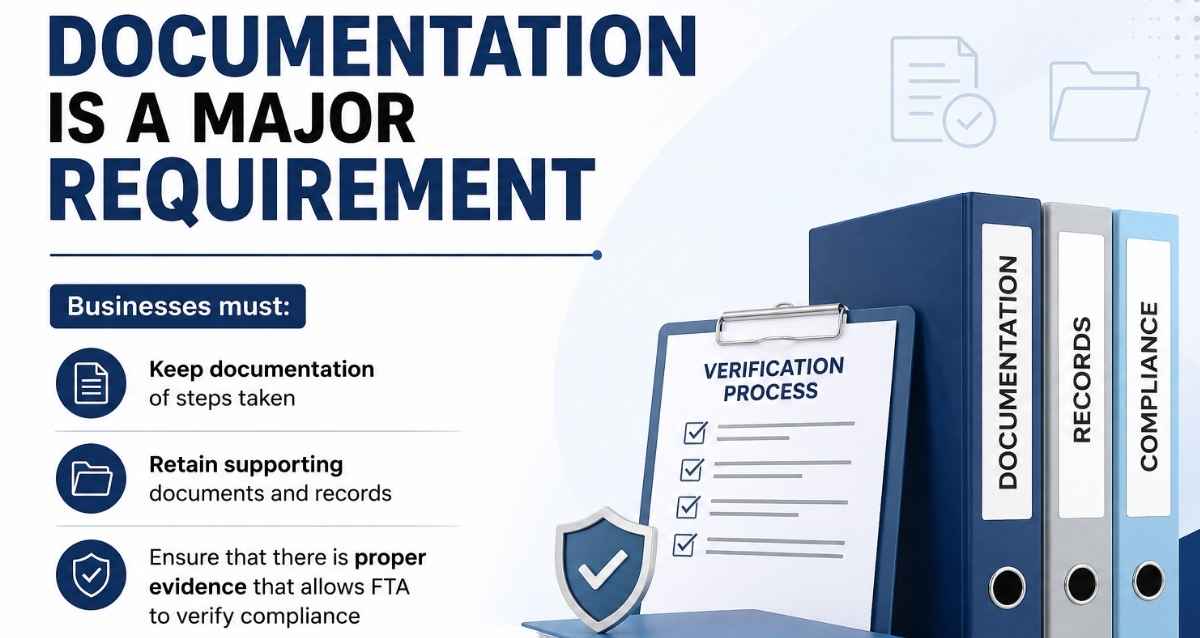
Documentation Is a Major Requirement
Businesses must:
- Keep documentation of steps taken
- Retain supporting documents and records
- Ensure that there is proper evidence that allows FTA to verify compliance
- Maintain a documented policy governing the process of verification
What Should a Supplier Verification File Contain?
A Supplier verification file containing relevant documents such as:
-
Trade license or incorporation documents
-
Supplier identification documents where applicable
-
Identification of authorised representatives
-
Verification of supplier address
-
Evidence of business premises
-
Confirmation of supplier bank account
-
Review from publicly available sources
-
Assessment of risk
-
Contracts
-
Purchase orders
-
Invoices
-
Delivery documents
-
Payment proof
-
Analysis of prices
-
Documents proving origin and ownership of goods
-
Explanations for identified risk indicators.
The exact documentation required will depend on the nature of the supplier and transaction.
Is There an Exception for Small Transactions?
Yes. The Decision provides an important exception.
A Taxable Person can avoid the specified verification measures and conditions where the value of taxable supplies, excluding VAT, is less than AED 10,000.
The AED 10,000 Exception Has an AED 100,000 Supplier Threshold
The small-transaction exception does not apply where the total value of supplies received from the supplier
- Exceeded AED 100,000 during the previous 12 months or
- It is expected to exceed AED 100,000 during the next 12 months.
Example
A business receives a single supply worth AED 8,000 excluding VAT.
Ordinarily, the transaction may fall within the small-transaction exception.
However, if the total value of supplies received from that particular supplier exceeded AED 100,000 over the previous 12 months, then the exception would not apply.
Common Mistakes Businesses Should Avoid
1. Treating the tax invoice as sufficient evidence
Under the new decision, there is a broader verification of suppliers and supplies.
2. Performing supplier checks only once
Existing suppliers also need to be re-verified where they have not been verified during the previous 12 months.
3. Ignoring supplier risk indicators
Frequent change of address or key persons and unusual transactions should also be assessed.
4. Not documenting explanations
When there is a risk indicator, the business should retain a clear and justified explanation.
5. Paying suppliers through unexplained third-party accounts
There should be a reasonable commercial explanation for unusual payment structures
6. Relying on cash without documentation
Cash payments need a documented commercial reason and must be within prescribed thresholds.
7. Ignoring the supplier's commercial licence
Businesses should consider whether the supplier is licensed and engaged to provide the relevant goods or services.
8. Failing to verify goods
In case of goods, authenticity, origin and ownership or disposal rights also need to be verified.
9. Assuming every transaction below AED 10,000 is exempt
The AED 10,000 exception is subject to the AED 100,000 supplier-level threshold.
10. Having no internal verification policy
Under this decision, there is a requirement of a documented policy identifying responsibilities and authority.
How Flyingcolour Tax Consultant Can Help
At Flyingcolour Tax Consultant, we will help businesses to be ready for the new requirements through:
- Review of UAE VAT compliance
- Review of Input tax taken
- Design supplier verification framework
- VAT health checks
- Supplier risk assessment procedures
- Review of VAT documentation
- Review of accounts payable and procurement process
- Preparation for FTA audit
A well-designed verification process will help businesses to establish stronger evidence supporting their input tax claims and reduce the risk of non-compliance.
Frequently Asked Questions
1. What is FTA Decision No. 13 of 2026?
FTA Decision No. 13 of 2026 establish the measures, procedures and conditions that Taxable Persons must follow to verify the validity and integrity of supplies before claiming input tax. It will come into effect from 01st October 2026.
2. Do UAE businesses have to verify every supplier?
The Decision requires adequate verification of a supplier when dealing with them for the first time or when dealing with a supplier that has not been verified during the previous 12 months. In addition, each Taxable Supply received or accepted must be verified in accordance with the Decision.
3. What is the AED 375,000 supplier threshold under the new UAE VAT rules?
Where supplies received from a supplier exceed or are expected to exceed AED 375,000 in the next 12-month period, the Taxable Person must verify that the supplier has a bank account and go through the publicly available reviews and media coverage from reliable sources.
4. Can businesses skip the new verification requirements for invoices below AED 10,000?
They can, but the exception is subject to conditions. A Taxable Person may disregard the specified measures where consideration excluding VAT is below AED 10,000. However, the exception does not apply if the total value of supplies from that particular supplier exceeds or is expected to exceed AED 100,000 over the next 12-month period.
5. What records should businesses maintain under FTA Decision No. 13 of 2026?
Businesses should keep proper documentation of verification steps undertaken and retain supporting records that allow the FTA to verify compliance.(FF)*
To learn more about FTA Decision No. 13 of 2026: New VAT Input Tax Verification Requirements in the UAE, book a free consultation with one of the Flyingcolour team advisors.
Disclaimer: The information provided in this blog is based on our understanding of current tax laws and regulations. It is intended for general informational purposes only and does not constitute professional tax advice, consultation, or representation. The author and publisher are not responsible for any errors or omissions, or for any actions taken based on the information contained in this blog.