

UAE Excise Tax 2026: The New Sugar Tax Model Explained
The UAE has been taking numerous steps to enhance the well-being of its residents. Additionally, there is a new step taken by the FTA, which involves introducing a sugar-based excise tax model effective January 1, 2026. This change fundamentally showcases how sweetened beverages are taxed in the UAE, shifting from a flat-rate system to a tiered, sugar-content-based approach.
For businesses in the stream of FMCG, retail, distribution, and hospitality, this is not just a tax change, but it is more of a pricing, compliance, and product strategy transformation.
What Has Changed?
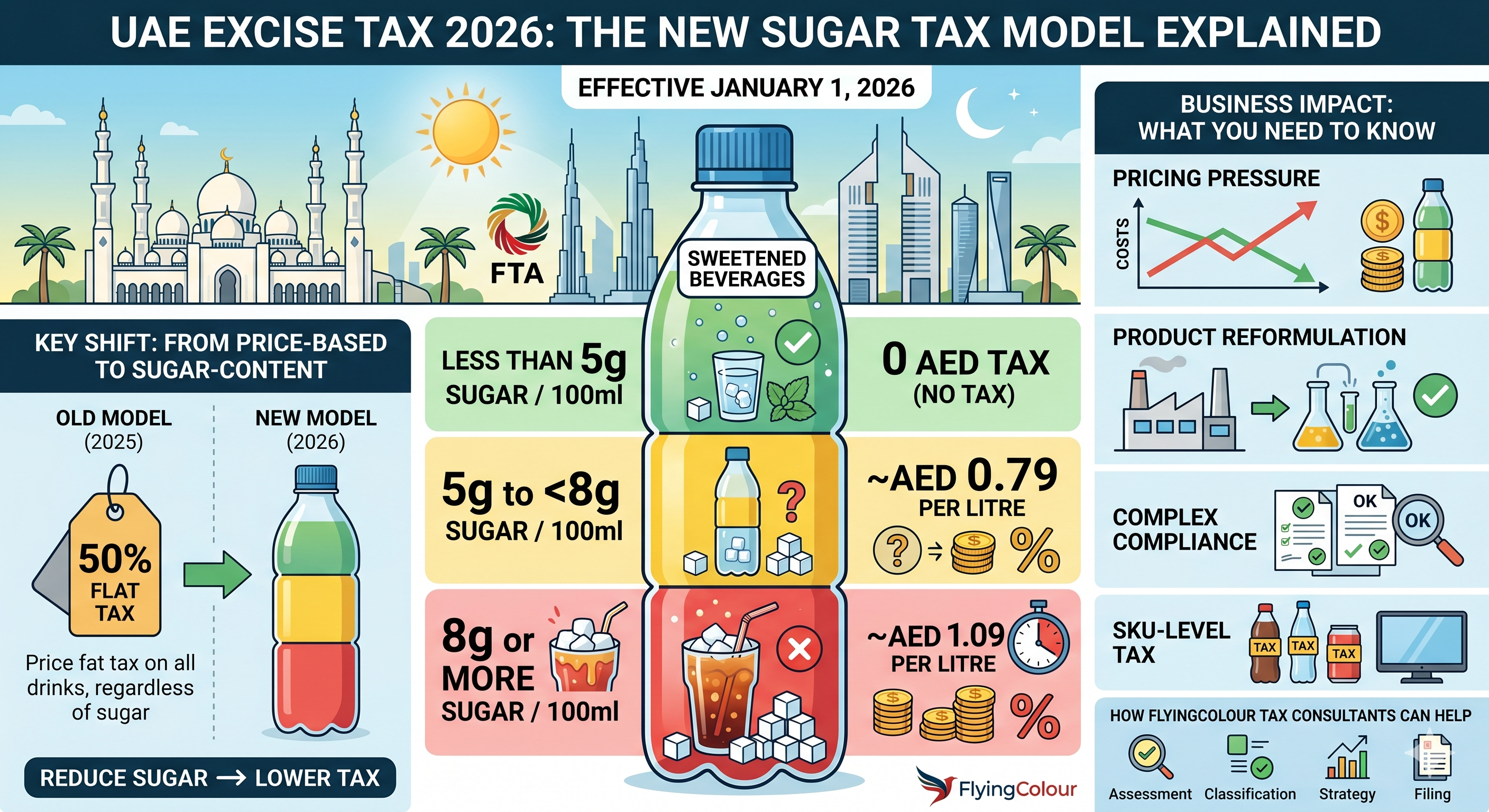
The previous excise tax rate applicable to sweetened drinks was 50% flat; now the Federal Tax Authority has replaced this with a tiered volumetric model based on sugar content.
This means:
- The tax is no longer linked to the product price
- Rather, it is now directly linked to grams of sugar per 100ml
How the New Sugar Tax Works?
As per the revised regulations, the beverages are taxed per litre depending on its sugar levels:
Sugar-Based Tax Structure (2026)
- Less than 5g sugar / 100ml → 0 AED (No tax)
- 5g to <8g sugar / 100ml → ~AED 0.79 per litre
- 8g or more / 100ml → ~AED 1.09 per litre
Drinks with artificial sweeteners only are subject to a 0% excise tax.
Key Shift: From Price-Based to Sugar-Based Tax
What has changed when compared to the existing regulations?
Previously, a flat rate of 50% tax was applied regardless of sugar level.
Now, two similar drinks can be taxed very differently based on sugar content. For example:
- Low-sugar drink → 0 tax
- High-sugar drink → Fixed cost per litre
We now understand that this fundamentally reshapes the pricing and profitability models of the businesses
Why the UAE Introduced This Model
This is the question of many. The UAE has come up with this reform, driven by:
1. Public Health Objectives
As we know, the UAE always looks into the benefits of its residents. By which, aiming to:
- Reduce sugar consumption
- Combat obesity and diabetes
- Encourage healthier alternatives
2. Industry Transformation
Also, this model pushes businesses to:
- Reformulate products
- Reduce sugar levels
- Innovate healthier options
In addition to the above, this step helps the UAE to align with global “sin tax” trends and GCC-wide reforms.
Business Impact: What You Need to Know
Certainly, by way of introducing the Sugar-Based Tax, there are various business impacts like:
1. Pricing Pressure on High-Sugar Products
- Fixed tax per litre increases the cost regardless of the retail price
- Low-cost, high-sugar drinks will be hit the hardest
2. Product Reformulation is now a Strategy
Considering the cost impact, the manufacturers are actively finding ways to:
- Reduce sugar content to fall below thresholds
- Introducing zero-sugar alternatives
3. Compliance is More Complex
When there is a rule, there should be records to be maintained. This means the businesses must now ensure to maintain the below documents:
- Accurate sugar content declaration
- Lab testing and certification
- Proper product classification
Be noted that incorrect classification of the product or failure to produce supporting documents can result in higher tax exposure and penalties.
4. SKU-Level Tax Calculation
As mentioned, each product is assessed individually, which means:
- Different flavours = different tax rates
- Small formulation changes = big tax impact
Common Risks Businesses Face
The common mistake that businesses would face, instead of the Sugar-based tax, will be:
· Incorrect sugar classification
- Lack of laboratory certification
- Misalignment between labelling and tax filings
- Pricing models not updated for the new tax structure
- Ignoring the impact on margins and the supply chain
Strategic Actions for Businesses
It is always necessary to stay compliant and competitive. Businesses should ensure that they:
- Conduct a Product Tax Review by means of assessing all the SKUs based on sugar levels
- Optimise Product Formulation - for small sugar reductions can lower tax bracket and improve margins
- Strengthen Documentation by way of maintaining adequate lab reports, conformity certificates and product registration data
- Revisiting the Pricing Strategy is suggested, in order to reflect the current reforms of fixed per-litre tax and the competitive positioning
- Train Internal Teams like finance, sales, and supply chain to ensure that they understand the tax implications, pricing changes and the compliance requirements
Expert Insight
We do not see this as just a tax reform, but it is a market behaviour shift. Businesses that adapt to the requirements quickly will:
- Gain pricing advantage
- Improve margins
- Align with consumer trends
And those who don’t will risk:
- Higher tax costs
- Reduced competitiveness
- Compliance penalties
How Flying Colour Tax Consultants Can Help
At Flying Colour Tax Consultants, we support businesses with:
- Excise tax impact assessment
- Product classification and compliance
- Tax-efficient pricing strategies
- End-to-end excise registration and filing
We help you to stay compliant while protecting profitability. The UAE’s sugar tax model sends a clear message: “The higher the sugar, the higher the tax.”
For businesses, the real question is, are you adapting your products and pricing or absorbing unnecessary costs?
Reach out to our experts for more clarity.
FAQ
1. What's changed about the 2026 excise tax compared to what we had before?
The previous model was a straightforward 50% tax on the product's retail price. But as of January 1, 2026, the UAE has flipped to a tiered system based on sugar content, no matter how much you're charging for the product.
2. What are the tax tiers based on the amount of sugar in a drink?
The new tax structure breaks down into three categories:
-
Products with under 5g of sugar per 100ml get off scot free - no tax is applied.
-
Products with 5g to under 8g of sugar per 100ml face a tax of approximately AED 0.79 per litre.
-
Anything with 8g or more sugar per 100ml will be hit with a tax of approximately AED 1.09 per litre.
3. Do drinks sweetened artificially still have to pay the sugar tax?
No. There's a special exemption for drinks that contain only artificial sweeteners, so long as they're below the sugar threshold - and that gives manufacturers a push to develop more sugar-free options.
4. How will this change affect the pricing of cheap drinks?
Expect to see the biggest price hikes on low-cost drinks that are also loaded with sugar. Because the tax is now a flat fee per litre, rather than a percentage of the price, the tax cost doesn't go down just because you're selling it cheaply.
5. What sort of documentation do businesses need to stay on the right side of the taxman?
To avoid getting into trouble and to keep their tax exposure under control, businesses will need to keep on hand:
-
Accurate labelling that actually shows the sugar content of every product.
-
Official lab results and certification to prove that the sugar content is really what it says it is.
-
And to sort out whether their products need special permits from the Federal Tax Authority (FTA).
To learn more about UAE Excise Tax 2026: The New Sugar Tax Model Explained, book a free consultation with one of the Flyingcolour team advisors.
Disclaimer: The information provided in this blog is based on our understanding of current tax laws and regulations. It is intended for general informational purposes only and does not constitute professional tax advice, consultation, or representation. The author and publisher are not responsible for any errors or omissions, or for any actions taken based on the information contained in this blog.