

Consolidated Tax Invoices in the UAE: A Practical Guide for VAT-Registered Businesses
Consolidated invoice is the colloquial way of calling the FTAs Summary tax invoice.
This is mostly used in cases where the business entity deals with the same customer a number of times in the same month, for recurring deliveries or orders. In the UAE, it is possible to sum up all transactions at the month end and make one summary tax invoice.
Let us understand in detail what it is, when you can use it, and what to watch out for.
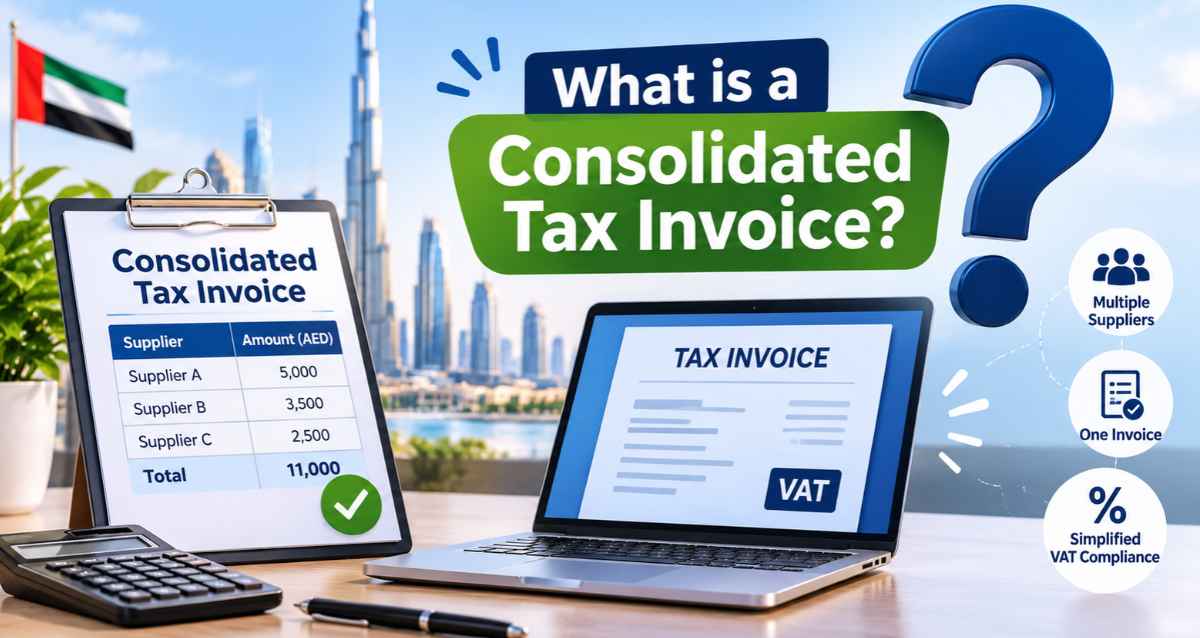
What is a consolidated tax invoice?
In simple words, it is one tax invoice raised to a client/customer who avails multiple supplies within a calendar month. Here, the customer will make more than one supply to the same customer in a calendar month; still, you may issue a summary tax invoice instead of separate invoices for each supply, as per Article 59(6). Once the business entity includes a supply in the summary tax invoice, Article 59(6) prohibits issuing separate invoices for supplies that are already included in it.
Why it matters
To facilitate the invoicing process for tax registrants against the requirement, as per the general rule in Article 67 of Federal Decree-Law No. 8 of 2017, that a registrant has to issue a tax invoice within 14 days of the date of supply. Now this rule becomes a burden for business entities with a high volume of transactions. Hence, the FTA has initiated this to ease the process by:
- One document per customer per month instead of dozens.
- Your customer's accounts payable team handles one invoice instead of many, which facilitates the overall process.
- Fewer documents means fewer chances of a missing or duplicated invoice.
This process is best suited for distributors, logistics providers, facilities management, staffing and recurring-service businesses, FMCG distributors, electronics wholesalers and pharmaceutical distributors. These entities frequently handle multiple transactions a day to the same customer and settle through a consolidated monthly statement.
The key rules
This system is available to every VAT-registered business, but certain rules must be followed.
1. Same customer, same calendar month
A summary tax invoice can be issued for one calendar month only. It cannot cover a quarter or a year. The month means the calendar month, not a flexible date range.
2. The 14-day clock starts at month end
The summary tax invoice must be issued to the customer within 14 days from the end of the calendar month in which the supplies took place.
3. It must carry full tax invoice details
There is no relaxation for a summary tax invoice. It must include all the mandatory details required for a full tax invoice under Article 59, along with a clear statement that the document covers multiple supplies.
In practice, the invoice must include
- The words Tax Invoice
- The supplier name, address and TRN
- The customer details
- A description and date of each supply, as a detailed item list
- The taxable amount, VAT rate and VAT amount in AED
- The exchange rate, if the invoice is issued in a foreign currency
4. Agreement with the customer
Both parties should agree to use a summary tax invoice. This can be recorded in a contract or followed as an accepted business practice.
Common mistakes to avoid
Though a summary tax invoice sounds simple, some common mistakes need to be avoided:
- Mixing months. It is to be generated only for the calendar month and never by combining transactions of 2 different months.
- Missing the deadline. The 14-day window runs from the end of the month and not from the date of each delivery.
- Double invoicing. Issuing individual invoices and a summary for the same supplies breaks the rule above.
- Thin descriptions. Just mentioning "Goods supplied in October – AED 50,000" is not acceptable. Details of each supply need to be mentioned in detail.
- Ignoring credit notes. In case of any corrections after issuing a summary tax invoice, it must go through a proper tax credit note as per Article 60.
E-invoicing: what's changing

Now that the UAE is moving towards mandatory electronic invoicing requirements, we are glad to know that the summary tax invoices are part of it as well.
The Ministry of Finance has implemented guidelines with a list of summary-invoice scenarios, where it is mentioned that multiple transactions with the same customer over a defined invoicing period can be consolidated into a single summary tax invoice.
However, the following are the two points to be followed for your business:
- Ensure that your ERP or accounting system is capable of supporting summary tax invoices in the required e-invoice format.
- Tax document requirements under Articles 59 and 60 have changed extensively, and administrative exceptions previously granted by the FTA are no longer available. Hence, review the changes before proceeding.
Practical Checklist
- Confirm the customer accepts monthly consolidated billing, and record it in your terms.
- Set a month-end process that issues summary invoices well before day 14.
- Make sure your template carries all Article 59 particulars and itemises each supply.
- Don't issue separate invoices for supplies already covered.
- Check that your accounting or e-invoicing system supports the summary scenario.
- Keep supporting delivery notes and records for each supply.
Final thoughts
Consolidated invoicing is a legitimate way to cut paperwork, but only if you follow the calendar-month and 14-day rules and include every required detail. With e-invoicing arriving, now is a good time to review your templates and system settings.
Disclaimer: This post is general information, not tax advice. VAT rules and FTA guidance change often, so confirm your specific situation with the Federal Tax Authority or a registered tax agent.
FAQs
1. What's a consolidated tax invoice in the UAE all about?
A consolidated tax invoice - or as it's also known, a summary tax invoice from the FTA - is a single invoice that one customer gets that covers all the supplies made to them in a calendar month. Its the opposite of having a separate invoice for each supply.
2. Who can actually use a consolidated tax invoice in the UAE?
Any business that's VAT registered can make use of a consolidated invoice, provided they're making more than one supply to the same customer in a single month. It's a good fit for businesses like distributors, logistics companies, facilities management, staffing, and all sorts of recurring-service providers - be it FMCG, electronics or pharmaceutical distributors.
3. When do I have to issue a consolidated tax invoice?
You've got two weeks, or fourteen days, to get a summary tax invoice out the door, but it's got to be from the end of the month when the supplies were made. That means you don't have to wait the whole two weeks from the date of each delivery.
4. Monthly - that's as long as a consolidated invoice can cover. Can't I do it quarterly or yearly?
No - a summary tax invoice is limited to covering one calendar month, and then it's got to be issued within that same month. You can't just lump all your invoices for different months together, or even do a quarterly or annual one.
5. What do I have to put on a consolidated tax invoice?
It's got to have all the same details as a regular tax invoice, including things like the supplier's name, address and TRN, the customer's details, what each supply was for, and the amount, VAT rate and VAT in UAE Dirhams, and also clearly show that it's a combined invoice for multiple supplies.
6. I've got a customer who wants a separate invoice for just one of their supplies - can I do that?
No - once a supply is included in a summary tax invoice, you can't just go ahead and issue a separate invoice for it afterwards. That's a pretty common mistake to make. If you find you've made a mistake like this you'll have to go through the process to correct it with a tax credit note.
7. Can I still do a consolidated tax invoice even if I'm using e-invoicing?
Yes. The Ministry of Finance has covered off summary invoices in their e-invoicing guidelines, and that includes things like combining multiple transactions with the same customer over a certain timeframe into one summary tax invoice. Just make sure your ERP or accounting system is up to issue summary invoices in the right e-invoice format.(SSK)*
To learn more about Consolidated Tax Invoices UAE: Rules, 14-Day Deadline & Tips, book a free consultation with one of the Flyingcolour team advisors.
Disclaimer: The information provided in this blog is based on our understanding of current tax laws and regulations. It is intended for general informational purposes only and does not constitute professional tax advice, consultation, or representation. The author and publisher are not responsible for any errors or omissions, or for any actions taken based on the information contained in this blog.