
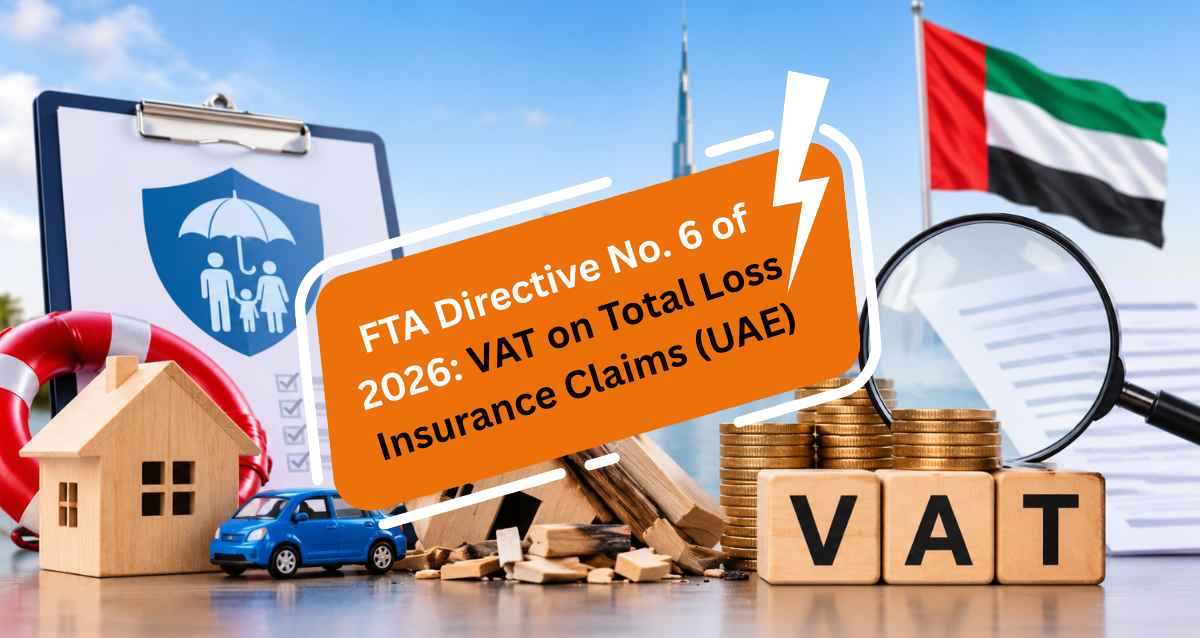
FTA Directive No. 6 of 2026: VAT on Total Loss Insurance Claims (UAE)
Let’s understand the applicability of UAE VAT on the total loss of insured assets via FTA Directive No. 6 of 2026, detailing the VAT treatment of insurance claims, VAT on insurance compensation and VAT on the transfer of damaged assets.
How does business insurance work?
In real time, when a business asset is damaged beyond repair, the insurance company may settle the insurance claim by paying compensation and taking ownership of the damaged asset.
Now the biggest question is: does transferring ownership of the insured asset to the insurance company create a taxable supply under UAE VAT?
The Federal Tax Authority (FTA) has addressed this issue through Directive on Tax Transactions No. 6 of 2026, dated 18 November 2026.
This directive clarifies that transferring ownership of an insured asset to an insurance company as part of a total loss insurance settlement will not be treated as a supply of goods for VAT purposes, provided certain conditions are met.
This clarification is important for businesses, insurance companies and VAT-registered entities dealing with damaged vehicles, machinery, equipment and other insured assets.
When Does the Transfer of an Insured Asset Become Outside the Scope of VAT?
Under Directive No. 6 of 2026, when an insured asset is considered a total loss because it cannot be economically or safely repaired, transferring its ownership from the insured person to the insurance company as part of the insurance claim settlement will not be treated as a supply of goods.
Though the FTA has confirmed the above, this treatment is subject to one important condition, which is:
The transfer must not be made in return for separate consideration independent of the insurance compensation.
Which means, when the insurance company takes ownership of a written-off asset as part of its settlement process of the insurance claim, the transfer by itself will not be treated as a taxable supply.

Is Insurance Compensation Considered Payment for the Asset?
This is one of the primary questions, and this directive clarifies two important points.
1. Insurance compensation is not consideration for the asset transfer.
To be precise, the amount paid by the insurance company to the insured person under the insurance contract is considered to be compensation for the insured loss. This is not treated as payment for transferring ownership of the asset.
2. The insurance company's valuation is not consideration.
Please be informed that the value assigned by the insurance company towards the damaged asset for calculating the loss or determining the insurance compensation will not be treated as consideration for the transfer.
This distinction helps businesses avoid treating the insurance settlement as a sale transaction for VAT purposes.
Does Deregistration of the Asset Affect the VAT Treatment?
No, definitely NOT!
The best part is that the FTA has clarified that the VAT treatment will not change based on administrative, regulatory or legal procedures required to be completed as part of the insurance claim or transfer of ownership.
This includes deregistering the insured asset with the relevant authority.
Hence, even if a vehicle or other registered asset must be officially deregistered before ownership is transferred to the insurance company, this administrative process does not change the VAT treatment explained in the directive.
What Happens When the Insurance Company Sells the Damaged Asset?
This is an important distinction.
Although the initial transfer from the insured person to the insurance company is not treated as a supply of goods under the conditions explained above, the subsequent sale of that asset by the insurance company is treated as a supply of goods.
For example:
A company owns a vehicle insured for AED 150,000. Following an accident, the vehicle is declared a total loss because it cannot be economically or safely repaired.
The insurance company settles the claim by paying AED 120,000 and takes ownership of the damaged vehicle.
- Transfer from the insured company to the insurer: Not treated as a supply of goods for VAT purposes, provided the directive's conditions are met.
- Insurance compensation of AED 120,000: Not consideration for the asset transfer.
- Subsequent sale of the damaged vehicle by the insurer: Treated as a supply of goods, subject to the general UAE VAT rules.
The VAT treatment of the insurance company's subsequent sale must therefore be assessed separately.
Documentation and Records Businesses Should Maintain
The directive also places importance on maintaining supporting documents.
Both the insured person and the insurance company must retain documents and records supporting:
- The determination of the insured asset as a total loss.
- Evidence that the asset cannot be economically or safely repaired.
- The insurance claim and its settlement.
- The transfer of ownership of the insured asset.
- The insurance compensation paid under the policy.
Businesses should ensure that these documents are properly maintained as part of their VAT records.
What Should Businesses and Insurance Companies Do?
Following this clarification, businesses and insurance companies should review their existing VAT treatment for total loss insurance settlements.
Businesses should ensure that the transfer of a written-off asset is not incorrectly reported as a taxable supply where the conditions of the directive are satisfied.
Insurance companies should separately assess the VAT implications when they subsequently sell or transfer ownership of the recovered asset.
Proper documentation is equally important to support the VAT treatment adopted during an FTA audit.

Conclusion
FTA Directive No. 6 of 2026 provides an important clarification on the VAT treatment of transferring insured assets to insurance companies in total loss cases.
The key takeaway is that the initial transfer of a total loss asset to the insurer as part of an insurance settlement is not considered a supply of goods, provided there is no separate consideration independent of the insurance compensation.
However, when the insurance company subsequently sells the asset, that transaction is treated as a supply of goods and must be evaluated under the general UAE VAT provisions.
Businesses should review their insurance settlement procedures, VAT reporting and supporting documentation to ensure the correct treatment is applied.
How Flying Colour Tax Consultant Can Help?
Flying Colour Tax Consultant assists businesses with UAE VAT advisory, transaction reviews, VAT compliance, tax return preparation and FTA audit support.
If your business deals with insurance settlements, damaged assets or total loss claims, our VAT specialists can help review the applicable VAT treatment and ensure appropriate compliance.
Contact Flying Colour Tax Consultant for professional UAE VAT advisory and compliance support.
Disclaimer: This article is for general information only and should not be treated as tax or legal advice. The VAT treatment of individual transactions depends on the facts and applicable UAE VAT legislation.
FAQs: UAE VAT on Total Loss of Insured Assets
1. What is this FTA Directive No. 6 of 2026 all about?
It's the Federal Tax Authority laying down the law that if an insured asset gets written off and handed over to the insurer as part of a claim, that's not classed as a sale for VAT purposes.
2. Does VAT kick in if you hand over a damaged item to an insurance company?
No, assuming the damage is so bad the thing is a total write-off, and you're only swapping it for the insurance pay-out; no separate cash changes hands.
3. Does the compensation from the insurer get treated as payment for the asset?
No way. The insurance pay-out is for the damage, not for taking over the asset. The company's valuation of the asset at the time is not really about the cash changing hands.
4. Does deregistering the asset before transfer change anything?
Nope. Whether it's all bureaucratic - paperwork and whatnot - the asset is deregistered or the transfer is done, it still falls under the same VAT rules.
5. Is the insurance company on the hook for VAT if they go on to sell the damaged asset?
Unfortunately yes. If they do decide to sell the asset down the line, that's treated as a proper sale and will need to be done according to normal UAE VAT rules.
6. Which assets does this directive cover?
It covers all the things that can't be fixed for cost or safety reasons - wrecked cars, machinery, equipment, just about anything insured that gets written off as a total loss.
7. What records do insurance companies and businesses have to keep for total loss claims?
Both will need to keep proof of the write-off, that the damage can't be fixed, the claim payout, and what cash changed hands to prove the asset was transferred over.(SSK)
To learn more about UAE VAT on Total Loss of Insured Assets: What Does FTA Directive No. 6 of 2026 Clarify?, book a free consultation with one of the Flyingcolour team advisors.
Disclaimer: The information provided in this blog is based on our understanding of current tax laws and regulations. It is intended for general informational purposes only and does not constitute professional tax advice, consultation, or representation. The author and publisher are not responsible for any errors or omissions, or for any actions taken based on the information contained in this blog.